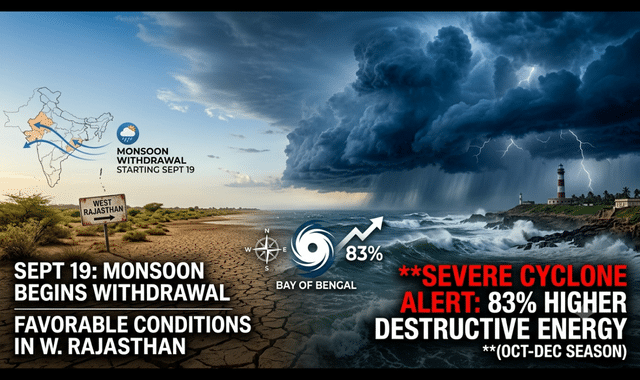
The southwest monsoon is preparing for its final act, but its departure is setting the stage for a turbulent and potentially destructive cyclone season.
According to the India Meteorological Department (IMD), atmospheric conditions are becoming highly favorable for the monsoon’s withdrawal starting September 19, initiating primarily from northwestern India, including parts of West Rajasthan.
The Lingering Monsoon in the East
While the retreat kicks off in the northwest, active weather systems in the Bay of Bengal are keeping rainfall steady across eastern India, particularly in Odisha. The state typically bids a complete farewell to the monsoon between October 10 and 15. Meteorologists note that the monsoon’s strength will gradually wane toward the final week of September, though an exact exit date for Odisha remains undetermined.
The Mechanics of the Cyclone Threat
The transition period following the monsoon’s retreat is notorious for triggering the region’s cyclone season. As atmospheric cloud cover dissipates, sea surface temperatures naturally rise. Concurrently, vertical wind shear—the difference in wind speed and direction at various altitudes—decreases significantly. These shifts create a highly volatile breeding ground where even a minor low-pressure system can rapidly accumulate energy and intensify into a formidable storm.
ISRO Warns of Unprecedented Storm Energy
The post-monsoon months of October through December are raising elevated alarms this year. Forecasts indicate the potential formation of three cyclones in the North Indian Ocean, encompassing both the Bay of Bengal and the Arabian Sea. While three storms during this quarter align with historical norms, their projected intensity is a major cause for concern.
According to precise assessments by ISRO’s Space Applications Centre (SAC), the cumulative destructive energy of these cyclones could surge to approximately 83% above the 44-year historical average for the October-December period. This dramatic spike does not imply that every individual storm will be 83% stronger. Rather, if a single severe cyclone maintains its peak intensity over an extended duration, it can aggressively drive up the total seasonal energy metric.
For Odisha, a state historically vulnerable to catastrophic autumnal cyclones, October and November demand high alert. The IMD’s extended forecasts warn that if these highly energetic systems track toward the eastern coast, the region could face severe multi-hazard scenarios, including gale-force winds, extreme precipitation, massive storm surges, and extensive inland flooding.