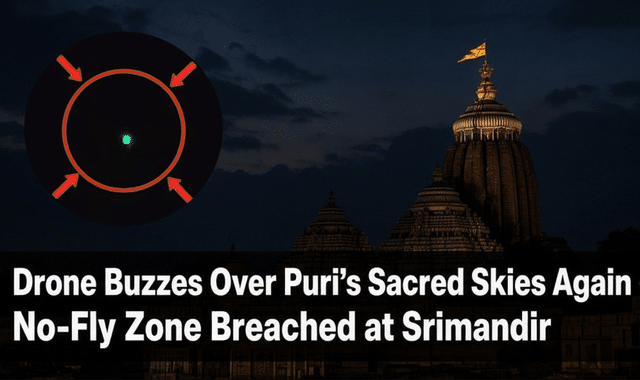
A drone was seen flying over the Shree Jagannath Temple on Friday, slicing through airspace that is supposed to be sealed. The sighting — from the Singhadwara (Lion Gate) up to the sacred Nilachakra on the temple’s peak — has again put the shrine’s security under a harsh spotlight.
The 12th-century Srimandir is among India’s most sensitive religious sites. The Directorate General of Civil Aviation has marked the temple area a “Red Zone,” restricting manned aircraft, unmanned aircraft and remote-controlled drones without Central government clearance. The restriction, notified in 2025, remains in force until September 25, 2028. Local rules already treat unauthorised drone flight over the shrine as a punishable offence. Yet the drone still flew.
Witnesses and reports say the aircraft was visible over the approach from Singhadwara towards the Nilachakra. Once the footage and eyewitness accounts reached officials, questions followed immediately: How did it enter a declared no-fly zone? Who was at the controls? What was the purpose — curiosity, photography, or something more serious?
Police have opened an inquiry through Singhadwara police station to identify the operator and the motive. As of Friday evening, no arrest had been publicly confirmed in this latest case. That silence itself has added to public unease.
This is not a one-off scare. Odisha’s Law Minister told the Assembly earlier this year that police had seized 10 drones flown illegally over the temple in about 20 months from June 2024, with cases registered at Singhadwara police station. In June 2026, police detained a man from Jajpur after a drone was spotted over the temple corridor. In July, a tourist from Kolkata was held after a dawn flight near the shrine, just days before Rath Yatra. Each time, equipment was seized. Each time, the same promise followed: stricter action. Each time, another drone appeared.
Devotees and servitors are no longer treating these flights as isolated mischief. They see a pattern — and a gap. A place where mobiles are restricted, photography of the inner sanctum is barred, and even commercial flights traditionally avoid the airspace out of reverence should not, they argue, be this easy to overfly. Calls have grown for anti-drone systems, tighter perimeter watch and faster identification of operators, not just after-the-fact seizures.
Temple security is not only about crowds at the gates. It is also about the sky above the Nilachakra — the disc that devotees look up to as a living symbol of Lord Jagannath. When an unidentified machine can trace that line from the Lion Gate to the crown of the temple, the breach is both physical and symbolic.
Police say the investigation will examine who flew the drone and why it was taken over Srimandir. Until that answer comes, Friday’s flight will sit with the earlier cases as another reminder: declaring a no-fly zone is not the same as enforcing one.
For now, the questions hanging over Puri are simple and unresolved. Who sent the drone? What did it see? And how many more times will the same story return before the sky over Srimandir is actually closed?