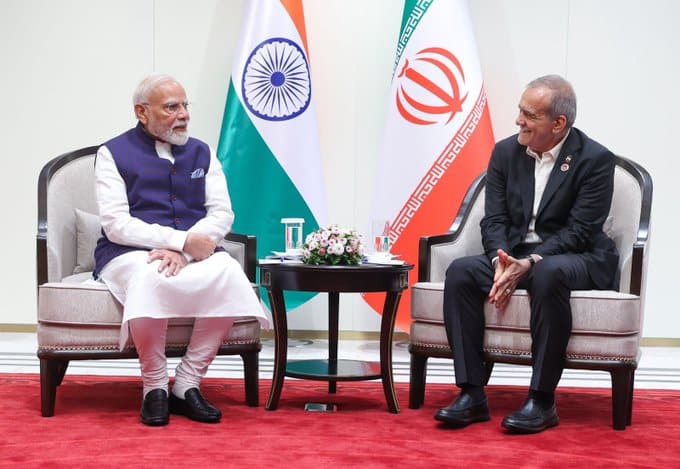
Prime Minister Narendra Modi met Iranian President Masoud Pezeshkian in Bishkek on Monday, using a sideline conversation at the Shanghai Cooperation Organisation Summit to send a clear message: India wants stronger ties with Tehran, but it also wants the guns to fall silent and the sea lanes to stay open.
The talks, confirmed by the Press Information Bureau, were their first face-to-face encounter since the latest flare-up in West Asia earlier this year. The two leaders have spoken by phone through the crisis, most recently on 30 June. In Bishkek they reviewed the full range of bilateral relations and compared notes on a conflict that has rattled energy markets and shipping routes far beyond the region.
Modi expressed concern at the escalation and restated India’s long-held line that disputes must be settled through dialogue and diplomacy, not by force. He pressed for “continued efforts to ensure lasting peace and stability” and put special weight on the safety of ordinary people and the arteries of global trade. Civilians and civilian infrastructure, he said, including commercial shipping and seafarers, “must not be harmed under any circumstances.” Freedom of navigation and commerce, he added, has to be safeguarded.
That emphasis is not abstract for New Delhi. A large share of India’s energy imports and many Indian-flagged or Indian-crewed vessels pass through West Asian waters, including the Strait of Hormuz. Disruptions there raise freight and insurance costs and put sailors at risk. After the meeting, Modi wrote that India remains committed to a long-standing friendship with Iran “across diverse sectors” and wants to “expand and diversify our trade basket in the times to come.”
The conversation also looked ahead to multilateral work. Modi reiterated India’s readiness to cooperate closely with Iran in BRICS and the SCO, and said he looked forward to welcoming Pezeshkian to India for the BRICS Summit. Iran became a full SCO member in 2023 and joined BRICS in 2024; India is hosting BRICS leaders in New Delhi in mid-September. A visit by the Iranian president would give the two sides another chance to talk trade, connectivity — including the Chabahar port project — and the still-fragile situation in West Asia.
The meeting unfolded as the 26th SCO Summit opened in Kyrgyzstan, marking 25 years of a grouping that now includes China, Russia, India, Pakistan, Iran, Belarus and the Central Asian states. Leaders in Bishkek are discussing security, terrorism, energy, transport and digital cooperation at a moment when wars in West Asia and Ukraine hang over the agenda. Modi is also scheduled for other bilateral talks in the Kyrgyz capital, including with Russian President Vladimir Putin.
For India, the Pezeshkian meeting is an exercise in balance: keep an old civilisational and commercial partnership alive, protect Indian energy security and seafarers, and insist that even a crowded, angry region still has room for diplomacy. Whether that message travels from the SCO halls in Bishkek to the waters of the Gulf is the test that will follow the handshake.