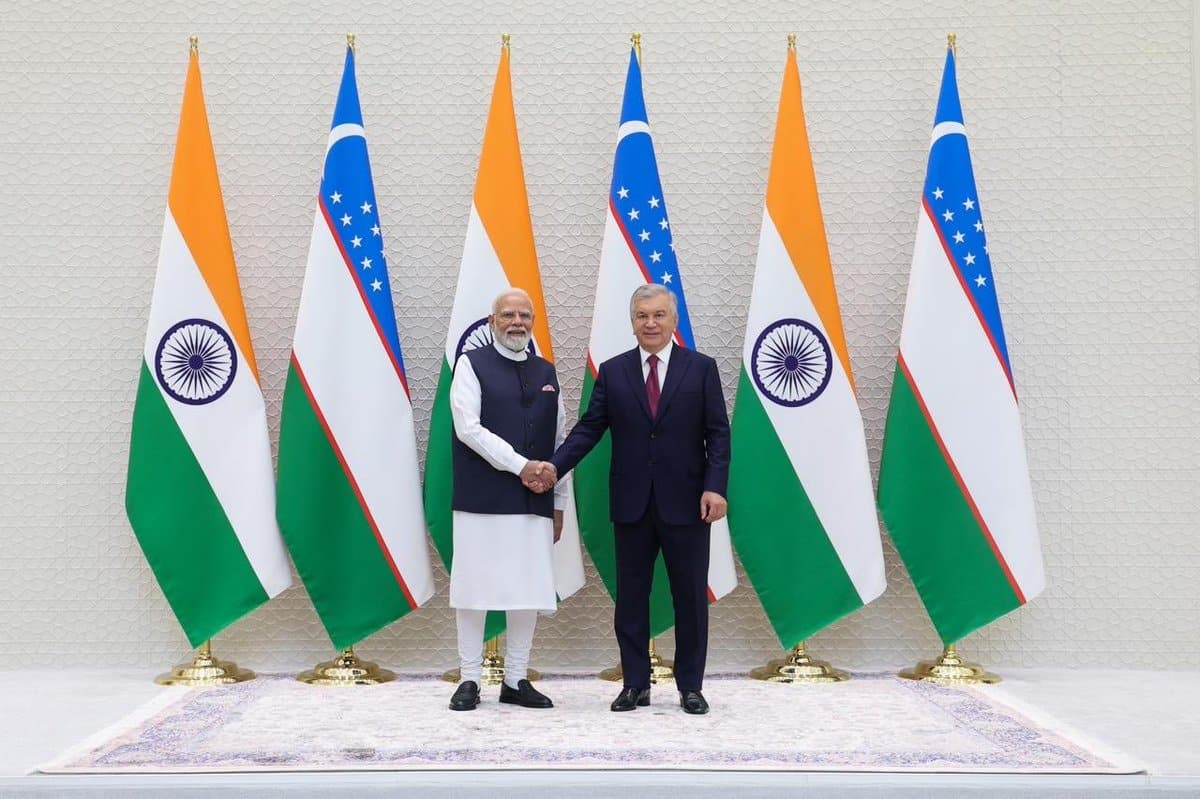
Prime Minister Narendra Modi and President Shavkat Mirziyoyev used a two-day state visit to recast India–Uzbekistan relations as a Comprehensive Strategic Partnership, pairing civilisational warmth with a hard agenda on trade, minerals, connectivity and security.
The talks at the Kuksaroy Presidential Palace on 30 August 2026 marked Modi’s fourth visit to Uzbekistan and came as the two countries mark 15 years of their existing strategic partnership. Officials said bilateral trade has already crossed $1 billion. The leaders now want that figure to reach $5 billion by 2030, backed by a planned business summit, work on non-tariff barriers, and closer links between Invest India and Uzbekistan’s investment agency.
The joint statement issued after the meeting described the atmosphere as warm and constructive. It also laid out an institutional upgrade: a Foreign Ministers-led mechanism to track agreements, plus a plan to raise the inter-governmental commission to ministerial level. Uzbekistan again backed India’s bid for a permanent seat on a reformed UN Security Council. Both sides pledged closer coordination in the Shanghai Cooperation Organisation, the Global South, and other multilateral forums.
Security language was unusually direct. The leaders condemned terrorism “in all its forms and manifestations,” including cross-border terrorism, rejected any justification for it, and called for action against financing networks, safe havens and facilitators. They pointed to the Joint Working Group on Counter Terrorism and to the Dustlik joint military exercise, last held in Uzbekistan’s Namangan Region in April 2026, as proof that defence cooperation is already moving from symbolism to routine work.
Economic and resource diplomacy filled much of the rest of the agenda. India and Uzbekistan agreed to expand cooperation in geology, mining, processing and recycling of critical and strategic minerals, and expressed interest in peaceful uses of nuclear energy. Indian companies were encouraged to look at Uzbek mineral deposits; Uzbek firms were invited the other way. Renewable energy, energy infrastructure and supply-chain resilience sat alongside that minerals push.
Digital cooperation was equally specific. The first IT Park in Tashkent, set up in 2019 on an Indian model with support from Software Technology Parks of India, was cited as a success. The sides agreed to go further on safe and trustworthy AI, startups, cybersecurity and space applications. A commercial arrangement between NPCI International Payments and Uzbekistan’s National Interbank Processing Centre will let Indian UPI apps scan the national UZQR code for merchant payments—another small but concrete export of India’s digital public infrastructure.
People-to-people measures gave the visit its historical colour. India announced a $1 million grant under its Grant-in-Aid framework for greening and ecological work in the Aral Sea region, linking Uzbekistan’s “Yashil Makon” drive with India’s “Ek Ped Maa Ke Naam” campaign. A Letter of Intent covers conservation and restoration of the ancient Buddhist sites of Fayaz Tepa and Karatepa in Termez. A Cultural Exchange Programme for 2026–2030, an archives MoU, and an agreement on Ayurveda and other traditional systems of medicine were also signed.
Human-resource numbers already run deep: more than 2,700 Uzbek nationals have trained under India’s ITEC programme, and more than 400 students have received ICCR scholarships, including under AYUSH. New Lal Bahadur Shastri scholarships for Hindi in Uzbekistan and an ICCR Sanskrit chair at Tashkent State University of Oriental Studies were announced to thicken those links.
Modi thanked Mirziyoyev for the hospitality and invited him to India. From Tashkent the Indian prime minister was due to travel on to Bishkek for the SCO summit—another reminder that the Uzbekistan stop was both a bilateral reset and a regional positioning exercise. The statement’s recurring phrase was “long-term, mutually beneficial cooperation.” The test will be whether the new mechanisms, the trade target and the minerals and digital files move as fast as the language.