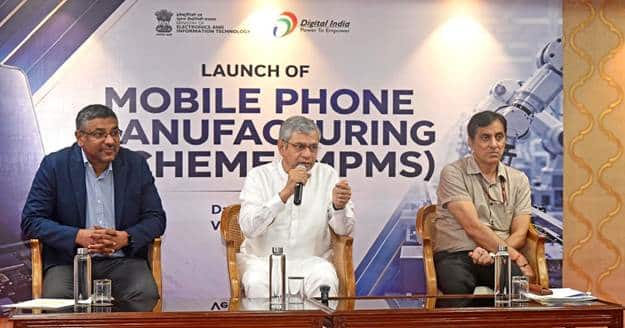
In a major boost to India’s electronics ambitions, the Ministry of Electronics and Information Technology (MeitY) on Thursday notified the Mobile Phone Manufacturing Scheme (MPMS) with a substantial budgetary outlay of ₹62,500 crore.
The five-year scheme (FY 2026-27 to FY 2030-31) aims to take India’s already impressive mobile phone manufacturing story to the next level—moving beyond assembly to deeper domestic value addition, genuine Indian intellectual property, and globally competitive homegrown brands.
Union Minister for Electronics and IT Ashwini Vaishnaw said the scheme will give a “significant impetus” to Indian-owned mobile brands, design, and intellectual property. “The design, intellectual property and brand must be Indian-owned and capable of competing with the best products in the respective market segment,” he emphasised, adding that the government will rigorously verify genuine Indian ownership of IP while developing non-fiscal support measures in consultation with industry.
Building on PLI Success
India is already the world’s second-largest mobile phone manufacturer by volume. An impressive 99.2% of mobile phones sold in the country are now Made in India. Smartphones even overtook diesel and cut diamonds to become India’s single largest exported product category in 2025.
This transformation was powered largely by the Production Linked Incentive Scheme for Large Scale Electronics Manufacturing (PLI-LSEM), whose tenure ended on 31 March 2026. MPMS is designed to sustain and accelerate that momentum.
Two Target Segments, Clear Incentives
The scheme has two clear focus areas:
- Target Segment 1 (TS1): Incentivising large-scale mobile phone manufacturing with differentiated incentives ranging from 2.25% to 5%.
- Target Segment 2 (TS2): Supporting genuine Indian mobile phone brands with a 5% incentive, plus an additional 3% for Indian design and R&D. Non-fiscal support will also be provided.
An extra incentive of up to 1.5% is available under both segments for domestic sourcing of key components and sub-assemblies, provided at least 25% of total units manufactured in a year use localised components.
Eligibility criteria are stringent. For TS1, companies need a minimum turnover of ₹10,000 crore in FY 2025-26. For TS2 (Indian Brands), the bar is lower at ₹1,000 crore, but applicants must meet strict ownership tests: registered in India, IP and trademark held in India, management control with Indian citizens, more than 51% shareholding by Indian citizens, and in-house R&D and design capabilities in India.
Expected Impact
Over the scheme period, cumulative mobile phone production is projected to reach approximately ₹39 lakh crore, accompanied by a significant rise in exports. The initiative is also expected to generate around 60,000 direct jobs, reinforcing the electronics sector’s role as a major employer, particularly for young people from smaller towns and villages.
The notification of MPMS signals India’s determination to move from being a manufacturing powerhouse to a design and brand powerhouse in the global mobile ecosystem. With the right incentives, rigorous ownership checks, and continued policy support, the first truly strong indigenous mobile brand could emerge by mid-2027—exactly as Minister Vaishnaw has predicted.