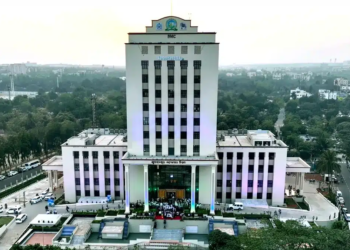

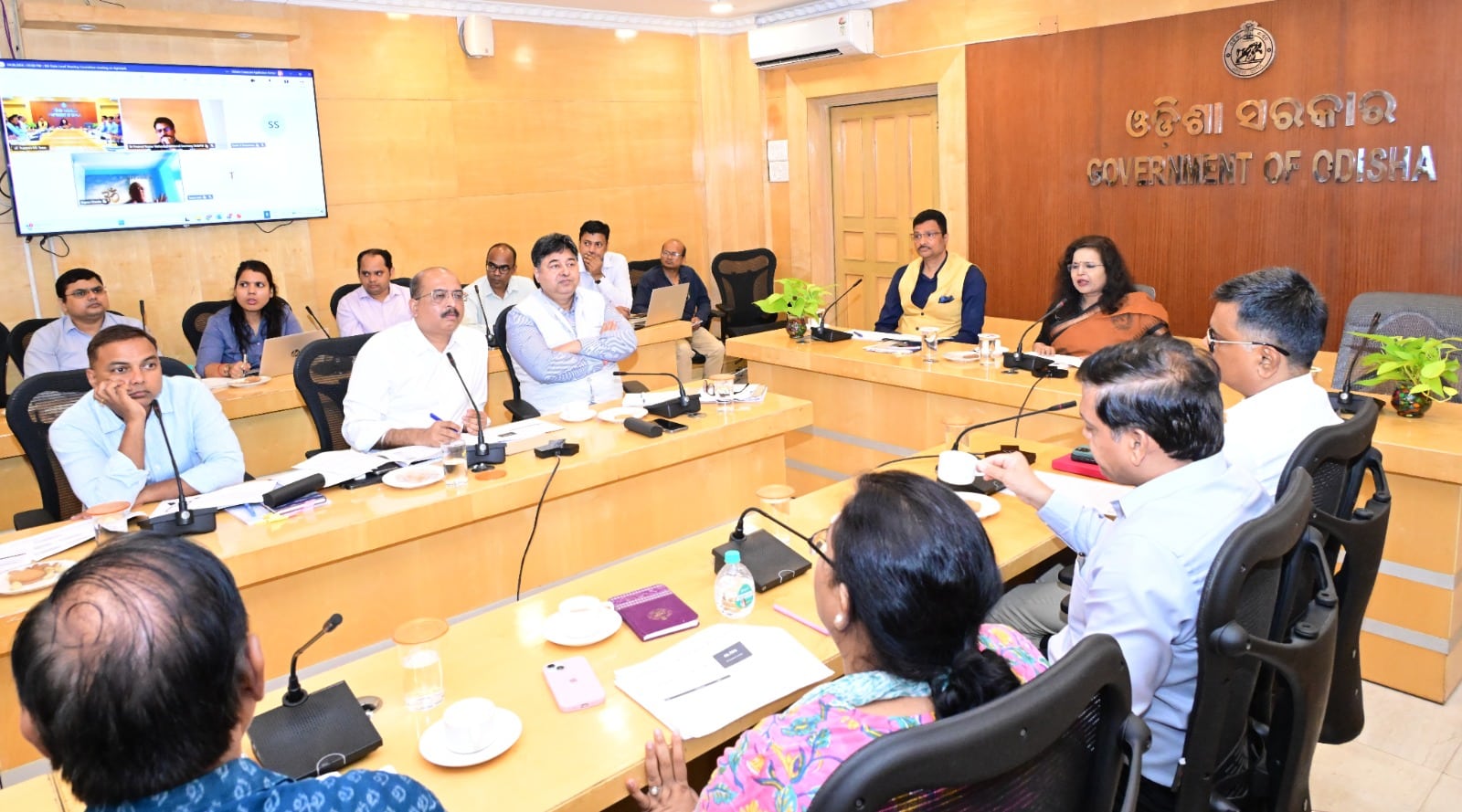
In a significant push towards digitising agriculture in the state, the 8th meeting of the State Level Steering Committee (SLSC) of AgriStack-Odisha was held under the chairmanship of Chief Secretary Anu Garg at the conference hall of Lok Seva Bhawan.
Senior officials including Additional Chief Secretary (Revenue & Disaster Management) Dr Arabinda Kumar Padhee, Principal Secretaries of Finance, Works, Food Supplies & Consumer Welfare, Commissioners-cum-Secretaries of Agriculture & Farmers’ Empowerment, Cooperation, Fisheries & Animal Resources Development, MSME and other departments attended the meeting. Union Ministry of Agriculture & Farmers Welfare Additional Secretary Dr Pramod Kumar Meherda and AgriStack Stack Mission Chief Knowledge Officer Shri Rajeev Chawla joined virtually.
AgriStack is a flagship digital initiative jointly implemented by the Government of India and state governments. It aims to create a unified digital platform where every farmer receives a unique Farmer ID, enabling seamless access to government schemes, crop advisory, crop insurance, institutional credit, input subsidies and other services. The platform is expected to enhance transparency, target benefits accurately and speed up service delivery.
Commissioner-cum-Secretary, Agriculture & Farmers’ Empowerment, Sachin Ramchandra Jadhav presented the latest progress. Against a target of 44,38,559 farmers across 30 districts, 20,75,683 farmers have already been registered. Jharsuguda leads with 75.78% coverage. Between January and July 2026, nearly 7 lakh farmers were registered, with May recording a high of 2,29,700 registrations.
The meeting reviewed the status of Digital Crop Survey (DCS) for Rabi 2025, during which 53,78,625 hectares were surveyed and crops identified in 19,91,110 hectares (about 37% of the surveyed area). For Kharif 2026, the survey will commence on August 16. Training of field staff at block and district levels is scheduled from August 5 to 17. The survey is expected to continue for 45 days to two months. Data collection will be undertaken approximately one month after sowing and at least 15 days before harvest for accurate crop identification.
Emphasis was laid on maintaining GPS accuracy — surveyors must stay within 10 metres of plot boundaries (tightened from 20 metres used in Rabi). The AI-enabled features in the DCS mobile application will be further strengthened for real-time identification and verification of paddy and non-paddy crops. Weekly block-level and fortnightly district-level monitoring meetings have been mandated.
The Chief Secretary directed all concerned departments to complete AgriStack-related works within stipulated timelines, ensure high data quality and authenticity, and conduct regular progress reviews. She also advised preparation of a clear Standard Operating Procedure (SOP) involving Revenue, Food Supplies & Consumer Welfare, and Agriculture departments to identify genuine farmers, sharecroppers and other cultivators so that no eligible farmer is left out of government benefits.
A proposal from the Centre for setting up an AgriStack Commissionerate was discussed. Odisha is considering a state-level structure headed by a Director-rank officer, supported by senior officials from Revenue, Agriculture, Electronics & IT departments, along with technical experts. District and block-level committees under Collectors and Tahsildars respectively, and a state-level Project Management Unit (PMU) will oversee implementation.
Chief Secy Garg underlined that authentic data generated through the Digital Crop Survey will serve as a reliable foundation for crop insurance, agricultural schemes, production estimation and policy formulation. She instructed that the survey must be completed on time, with complete transparency and high qualitative standards.
Officials present expressed confidence that AgriStack will emerge as a milestone in empowering farmers through technology and making government services more transparent, accountable and effective.