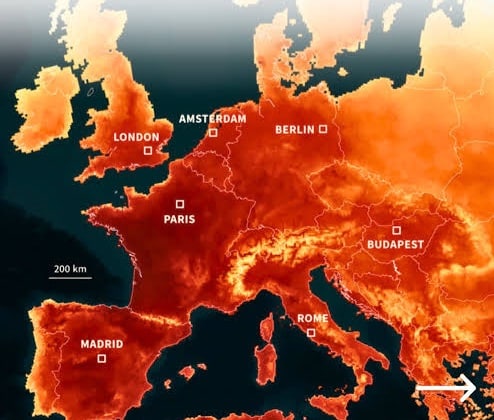
Europe is facing one of its most severe climate emergencies in modern history as an unprecedented heatwave continues to grip the continent.
The extreme temperatures have claimed more than 2,000 lives, overwhelmed healthcare systems, strained electricity and water supplies, and disrupted daily life across several countries.
Scientists and health experts have warned that the deadly conditions highlight the growing impact of climate change, with many regions experiencing record-breaking temperatures that were once considered exceptionally rare.
Spain Records Hottest First Half of the Year
Spain has emerged as one of the worst-affected countries during the ongoing heatwave.
According to Spain’s national weather agency (Aemet), the country has recorded its hottest January-to-June period since official records began. Average temperatures during the first six months of 2026 were around 1.6 degrees Celsius above normal levels.
June also became Spain’s second-hottest June on record, with temperatures averaging 3.2 degrees Celsius above seasonal norms.
The country’s Carlos III Health Institute reported more than 1,000 heat-related deaths during June alone, more than double the number recorded during the same month last year.
France Faces Rising Death Toll and Political Pressure
France has also experienced devastating consequences from the prolonged heatwave.
Health authorities estimate that at least 1,000 people have died following an intense 11-day heatwave that broke multiple temperature records.
Although temperatures have temporarily eased in some areas, meteorologists have warned that another spell of intense heat could arrive during the coming weekend.
The French government is also facing mounting criticism over its handling of the crisis. Opposition leaders have questioned whether sufficient preparations were made to protect vulnerable communities as increasingly frequent heatwaves become the new normal.
Heatwave Expands Across Europe
The extreme weather has spread far beyond Western Europe.
Several countries have recorded unprecedented temperatures:
- Hungary registered a new national record of 42°C.
- Slovakia reached an all-time high of 41.3°C.
- Croatia’s coastal city of Split experienced its hottest day since records began.
- Germany recorded temperatures above 41°C.
- Poland exceeded 40°C.
- The Czech Republic also experienced record-breaking heat.
Water shortages have affected parts of Hungary and Slovakia, forcing authorities to deploy water tankers to supply residents. In Budapest, police used water cannons to help people cool down in public squares.
Meanwhile, the heat has expanded eastward into Ukraine, creating additional challenges for civilians and military personnel alike.
WHO Calls Extreme Heat a “Silent Killer”
World Health Organization Director-General Tedros Adhanom Ghebreyesus has described extreme heat as a “silent killer.”
He warned that Europe is warming faster than any other continent, with temperatures rising at roughly twice the global average.
According to the WHO, more than 1,300 excess deaths linked to high temperatures have been recorded across Europe since June 21, while national reporting now places the overall death toll above 2,000.
Health experts continue to advise people—particularly older adults, young children, and those with chronic medical conditions—to remain hydrated, avoid outdoor activity during peak afternoon hours, and seek cooler indoor environments whenever possible.
Scientists Link the Crisis to Climate Change
Climate researchers from the World Weather Attribution initiative concluded that the late-June heatwave would have been “virtually impossible” without human-induced climate change.
Meteorologists say the event has been intensified by an “omega block” weather pattern—a persistent high-pressure system trapped between two low-pressure areas. The phenomenon has prevented cooler air from entering large parts of Europe, allowing temperatures to remain exceptionally high for several consecutive days.
Scientists caution that, unless global greenhouse gas emissions decline significantly, severe heatwaves are likely to become more frequent, longer-lasting, and increasingly dangerous.
UK May Face Another Heatwave
While temperatures have temporarily fallen across much of the United Kingdom, forecasters say another period of unusually hot weather could develop during early July.
Some regions of England and Wales may once again see temperatures climb into the low-to-mid 30s Celsius, although weather agencies say there remains some uncertainty regarding the intensity of the next heatwave.
Europe Confronts a New Climate Reality
The ongoing heatwave has become one of the deadliest weather events Europe has faced in recent years. Beyond the tragic loss of life, the crisis has exposed growing vulnerabilities in public health systems, infrastructure, and water resources.
Experts believe the events of summer 2026 underscore the urgent need for stronger climate adaptation measures, improved heat preparedness, and long-term strategies to protect communities from increasingly frequent extreme weather.