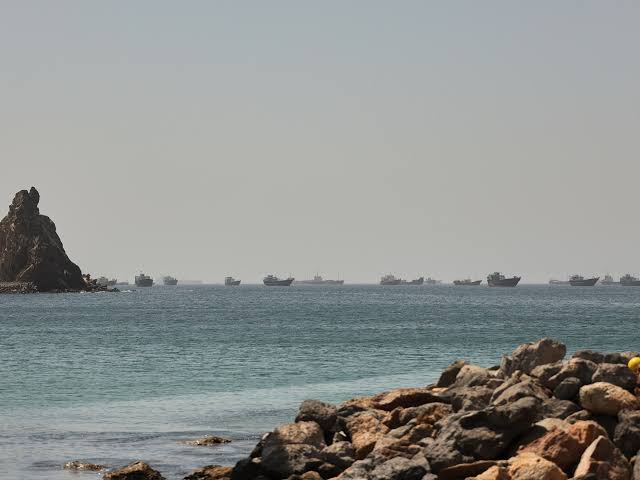
The fragile US-Iran ceasefire has come under renewed pressure after fresh military action and retaliatory warnings intensified tensions in the strategically crucial Strait of Hormuz, raising concerns about regional stability and global shipping security.
The latest escalation began after the United States carried out airstrikes on Iranian military targets, including missile and drone facilities as well as coastal radar installations. According to the US, the operation was launched in response to a drone attack on a commercial cargo vessel transiting the Strait of Hormuz.
The strikes marked one of the biggest challenges yet to the interim ceasefire agreement reached only a week earlier. The agreement had been intended to reduce hostilities and restore confidence in one of the world’s busiest maritime trade routes.
Iran Responds to US Military Action
Following the American strikes, Iran’s Islamic Revolutionary Guard Corps (IRGC) Navy claimed it had targeted US military positions in response to the attacks.
Iran, however, rejected Washington’s accusation that it violated the ceasefire.
Ebrahim Azizi, chairman of Iran’s parliamentary national security commission, argued that Iran’s actions were part of what he described as “ceasefire management” rather than a breach of the agreement.
He also reiterated Tehran’s position that all vessels navigating through the Strait of Hormuz should follow routes approved by Iranian authorities.
Trump Warns of Further Action
US President Donald Trump had hinted at possible retaliation after the reported drone attack on the commercial vessel.
When asked whether military action was being considered, Trump told reporters, “You’ll find out.”
Shortly afterward, US Central Command confirmed strikes on Iranian military infrastructure.
Speaking before the operation, Trump expressed dissatisfaction with the attack, stating that Iran had fired multiple shots despite the ceasefire understanding.
Diplomatic Communication Channel Remains Open
Despite the military escalation, both countries have reportedly established a direct communication mechanism designed to prevent misunderstandings in the Strait of Hormuz.
According to Iranian media reports, the communication channel was created following diplomatic discussions held in Zurich. The mechanism aims to reduce the risk of accidental escalation while supporting implementation of the existing ceasefire framework.
Iranian Deputy Foreign Minister Kazem Gharibabadi also stressed that safe maritime navigation must recognize Iran’s role as a coastal state responsible for the waterway.
Strait of Hormuz Remains Global Flashpoint
The Strait of Hormuz continues to be one of the world’s most strategically important maritime corridors, carrying a significant share of global oil shipments.
Although commercial shipping had begun recovering after the ceasefire, uncertainty over navigation rules has already disrupted vessel movements.
Reports indicate that some tankers turned back after disagreements over approved transit routes. Nevertheless, dozens of commercial ships continued using the southern shipping lane on Friday, highlighting the waterway’s continued importance to international trade.
Ceasefire Faces Critical Test
The latest military exchanges have placed the US-Iran ceasefire under significant strain. While both nations continue to maintain diplomatic communication channels, fresh strikes and retaliatory rhetoric have increased uncertainty over whether the agreement can hold.
With the Strait of Hormuz remaining central to global energy supplies and international shipping, developments in the coming days are expected to be closely watched by governments and markets worldwide.