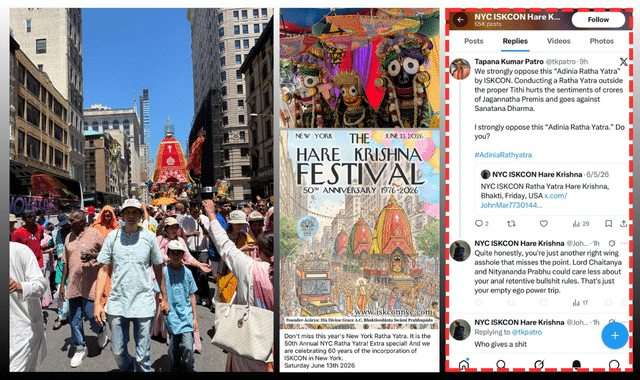
Under bright summer skies and the familiar beats of kirtan, ISKCON New York rolled out its 50th Rath Yatra on June 13. The towering chariot carrying Lord Jagannath, Balabhadra, and Devi Subhadra moved through Brooklyn streets, drawing hundreds of devotees and curious onlookers in what has become a cherished annual tradition for the temple over five decades.
Yet behind the festive facade, a storm of discontent has been brewing among Jagannath devotees across the United States, Australia, and beyond. A formal petition sent just days earlier to Temple President Hansarupa Dasa urged ISKCON New York to reconsider the date and align with the age-old tradition observed at the Sri Jagannath Temple in Puri, Odisha.
According to the June 9 petition, the scriptural tithi for Sri Jagannatha Ratha Yatra is Ashadha Shukla Dwitiya — which falls on July 16, 2026. The sacred nine-day observance period (Nabadinatmak Jatra) extends until Bahuda Yatra around July 24. Petitioners, including Dr. Debananda Pati (Houston, TX), Ajaya K Mohanty (Falls Church, VA), Arati Nanda Pati, and others from across the U.S. and Australia, argued that celebrating more than a month early deeply hurts the religious sentiments of millions who regard strict adherence to the Puri calendar as an expression of devotion and fidelity to centuries-old tradition.
“Untimely observance of Sri Jagannath Rath Yatra deeply hurts the religious sentiments of countless devotees,” the petition states. It references Srila Prabhupada’s own family background as worshippers of Lord Jagannath and notes that major Ratha Yatras during his lifetime were generally held on or near the prescribed tithi. The document respectfully acknowledges practical challenges like permits and logistics but pleads for harmony between those realities and scriptural principles.
A separate appeal from Dr. Shreekanta Nayak, President of Sri Jagannatha Universal Service Temple USA and other community organisations, reinforced the call: follow the exact dates published in the Sri Jagannath Panjika from Puri so that “our Sect Jatra [stays] together in unanimity and uniformity.”Despite these appeals, the festival proceeded on June 13. The very next day, criticism exploded across social media. Odia devotees and traditionalists labelled the event an “Adinia Ratha Yatra” (untimely chariot festival). One widely shared post by Tapana Kumar Patro on X read: “We strongly oppose this ‘Adinia Ratha Yatra’ by ISKCON. Conducting a Ratha Yatra outside the proper Tithi hurts the sentiments of crores of Jagannatha Premis and goes against Sanatana Dharma.”
The backlash quickly turned heated. Critics accused some ISKCON supporters of responding with character assassination and foul language, including derogatory terms directed at those who raised objections — even targeting Odias and references to the sacred land of Odisha. Screenshots of comment threads circulated widely, showing escalating exchanges where concerns about tradition were dismissed as “anal retentive” or ego-driven.
Adding significant weight to the criticism, Arabinda Kumar Padhi, Chief Administrator of Shree Jagannath Temple, Puri, publicly expressed deep sadness. He condemned any intentional hurt caused to devotees and stressed that true Jagannath bhaktas never deliberately wound others’ sentiments. He called for greater respect toward scriptures, traditions, and the sanctity of cultural heritage.
The controversy has laid bare a growing tension within the global Jagannath community: the balance between ISKCON’s success in spreading the festival to new audiences in the West through practical adaptations, and the insistence by many traditionalists — especially those with direct ties to Puri — that the core timing rooted in Odisha’s sacred calendar must remain non-negotiable.
The original petition ended on a note of humility: “This petition is offered not in a spirit of criticism or confrontation, but with humility, affection, and a sincere desire to uphold the sanctity of one of the world’s most sacred festivals.”
As the vibrant images and videos from last night’s procession continue to circulate, so too do calls for dialogue. Many devotees on both sides express hope that Lord Jagannath Himself will guide the community toward greater harmony — preserving both the global reach of the festival and the timeless traditions that give it its deepest spiritual power.
The debate is far from over. For millions of Jagannath devotees, the question remains: When does adaptation strengthen devotion, and when does it risk diluting the very sanctity devotees seek to protect?