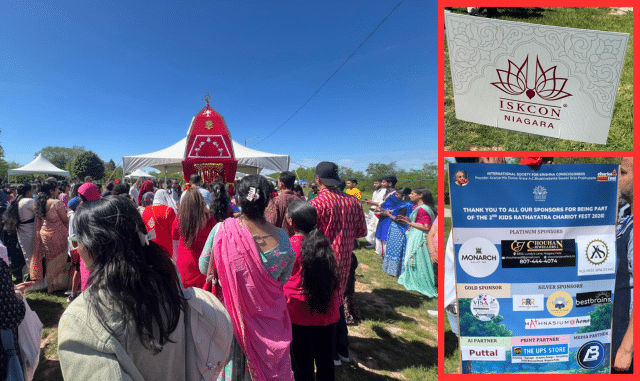
A wave of indignation is sweeping through Canada’s Odia diaspora after ISKCON organised “Unitimely Rath Yatra” events in Waterloo on May 30 and Niagara on May 31 – weeks before the divinely ordained lunar dates for Lord Jagannath’s sacred festivals.
In response, the Shree Jagannath Devotees of Canada, Toronto, has fired off a strongly worded open letter to the Temple President and Management Committee of Bhaktivedanta Manor and all ISKCON branches across Canada, demanding strict adherence to scriptural tithis.
Dated May 23, 2026, the letter – signed by prominent community leaders including Dr Sunanda Mishra Panda, Dr Tanmay Panda, and over a dozen other devotees – reminds ISKCON of the “inviolable scriptural and traditional basis” rooted in the Skanda Purana, Brahma Purana, Padma Purana, and Niladri Mahodaya.
“Snana Yatra (Snana Purnima) must be celebrated strictly on the Jyestha-Purnima tithi,” the letter states, “commemorating the First Manifestation and Most Holy Birthday of Mahaprabhu.” Rath Yatra (Gundicha Yatra), it continues, “must commence on the Asadha Shukla-paksha Dvitiya Tithi as a sacred nine-day festival (navadinatmaka-yatra) to commemorate the Lord’s sojourn to His birth-place.”For 2026, those dates are crystal clear: Snana Yatra on June 29 and Ratha Yatra beginning July 16, followed by Bahuda Jatra on July 24.
The devotees acknowledge the practical headaches of staging large chariot festivals in Canada – unpredictable weather, city permits, public safety, and the desire to hold events on weekends for maximum participation. They even invoke the Vedic principle of Desha-Kaala-Paatra nyaya, allowing flexibility in execution. But they draw a firm line: “A tithi is a divinely ordained lunar timing that remains fixed and cannot be altered for convenience.
”The letter highlights a growing trend in recent years where ISKCON temples worldwide have shifted Snana Yatra and Ratha Yatra to “arbitrary dates months in advance or scattered throughout the year,” a practice the signatories say violates ritual sanctity and deeply wounds the religious sentiments of millions of devotees, particularly the Odia community for whom Lord Jagannatha is not just a deity but the very embodiment of their spiritual, cultural, and emotional identity.“Celebrating these highly sacred pastimes on unprescribed days deeply impacts the religious sentiments of millions of devotees worldwide who hold the ritual integrity of the tradition dear,” the letter declares.
The appeal is not confrontational but collaborative. The devotees express “deep reverence for Shree Jagannatha Mahaprabhu and sincere appreciation for the monumental global service undertaken by ISKCON.” They pledge full cooperation, volunteering, and support to ensure the festivals are celebrated “safely, grandly, and in perfect alignment with the scriptures.” They also offer to share formal consents from ISKCON India endorsing the authentic Puri schedule.
The letter ends on a note of shared devotion: “We request this not in opposition, but out of a collective commitment to protecting the authenticity and glorious heritage of Lord Jagannatha for generations to come.”As Canada’s Hindu community watches closely, the protest raises a larger question for diaspora temples everywhere: In the quest for accessibility and convenience, can ancient lunar tithis – the very heartbeat of Sanatana Dharma – still be honoured?