India’s defence leadership tested advanced military technologies abroad before finalising major procurement decisions.
Defence Minister Rajnath Singh, Chief of Defence Staff General Anil Chauhan, and Air Chief Marshal AP Singh toured the US, UK, and Germany to evaluate systems in real-world conditions.
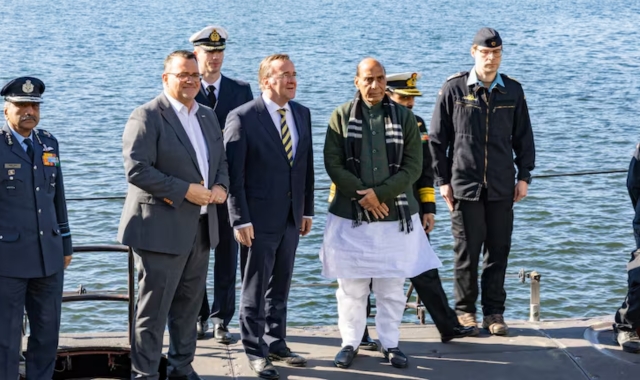
In the US, Rajnath Singh test-flew the Boeing F-15EX to assess its combat capabilities for the IAF’s 114 MRFA programme. General Chauhan’s UK visit focused on propulsion, cyber, and AI systems. AP Singh’s Germany trip advanced submarine cooperation, including Project 75I, which plans six air-independent propulsion submarines built in India with ThyssenKrupp Marine Systems and Mazagon Dock Shipbuilders.
India’s new procurement strategy emphasises performance-based evaluation over paper presentations. Leaders tested fighter jets, drones, naval systems, and cyber technologies to ensure operational alignment. The approach reflects lessons from past acquisitions and aims to strengthen indigenous manufacturing through co-production and technology transfer.
India and Germany signed a Defence Industrial Cooperation Roadmap, expanding collaboration in niche technologies and UN peacekeeping training. The submarine deal highlights India’s push for high indigenous content under the ‘Make in India’ initiative.
If trials lead to agreements, India could secure F-15EX or Rafale jets, expand drone fleets, and add advanced submarines, boosting deterrence against regional rivals. Delays or disagreements on technology transfer could shift India toward France or South Korea, influencing timelines and strategic balance.