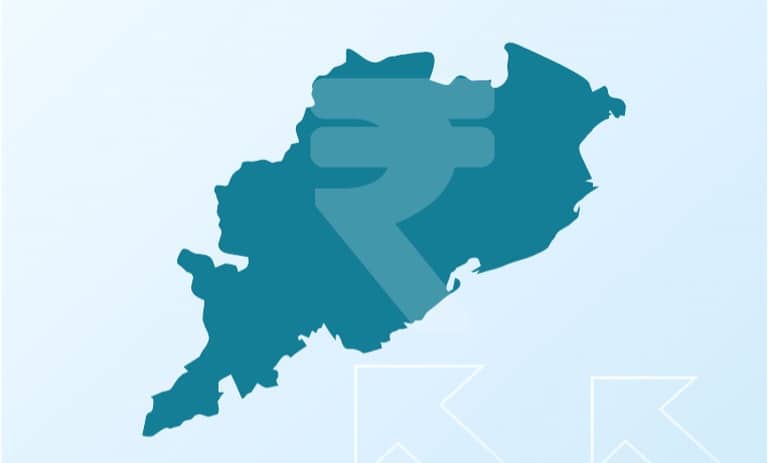
The Government of Odisha’s Economic Survey 2025-26 presents a strong growth narrative, with the state outperforming the national average across multiple indicators — from GSDP expansion and per capita income growth to agriculture, industry, infrastructure, and social development.
Here are the major highlights:
Economy Size and Growth
-
Odisha’s Gross State Domestic Product (GSDP) at current prices is estimated at ₹9.9 lakh crore in 2025-26, up 9.5% from ₹9 lakh crore in 2024-25.
-
Real economic growth is projected at 7.9%, higher than 7.2% last year and above the national average of 7.4%.
-
All sectors recorded robust growth, supported by rising public and private investment.
Per Capita Income Rises Faster Than National Average
-
Odisha’s per capita income increased by 9.2% to ₹1,86,761 in 2025-26.
-
The national per capita income grew by 6.9% during the same period.
-
The state is witnessing faster convergence with national income levels.
Rising Labour Force Participation, Especially Among Women
-
Overall Labour Force Participation Rate (LFPR) rose from 58.1% in 2022 to 64.5% in 2024, compared to the national average of 59.6%.
-
Female LFPR increased significantly from 37.6% to 48.7%, well above the all-India average of 40.3%.
Agriculture and Allied Sector Performance
-
Agriculture contributes 19.6% to the state economy, higher than the national average of 16.8%.
-
Sector growth stood at 5.3%, compared to 3.1% nationally.
-
Crop diversification into cotton, maize, vegetables, and spices is enhancing farmers’ income.
Record Foodgrain Production
-
Foodgrain output reached a record 150.5 lakh metric tonnes (MT) in 2024-25.
-
Rice production stood at 118.6 lakh MT, supported by schemes such as Samrudha Krushak Yojana and CM-Kisan.
Procurement Boost for Farmers
-
92.6 lakh MT of paddy procured from 20 lakh farmers.
-
₹21,300 crore paid as MSP and ₹7,140 crore as input subsidy.
-
Ragi procurement doubled, supported by incentive pricing.
Irrigation and Cropping Intensity
-
Irrigation potential expanded to 74.2 lakh hectares.
-
Cropping intensity improved to 165% in 2024-25, up from 158% in 2020-21.
Dairy, Poultry and Fisheries Growth
-
Milk production rose to 27.1 lakh MT, up 3%.
-
Egg production surged from 242 crore to 406 crore between 2020-21 and 2024-25 (CAGR 14%).
-
Odisha is the 4th largest fish producer and 3rd largest marine exporter. Fish production reached 11.92 lakh MT.
Industry and Investment Momentum
-
Industry contributed 41.3% of GSVA, valued at ₹3.6 lakh crore.
-
Manufacturing growth projected at 8.3%, higher than the national average.
-
244 new projects approved in 2025 with proposed investments of ₹5.66 lakh crore.
-
80 projects implemented, generating 1.4 lakh jobs.
Odisha achieved a 98% implementation rate under the Business Reforms Action Plan (BRAP) 2024 and introduced the Odisha Jan Vishwas Bill 2025 to simplify compliance.
Services Sector Expansion
-
Services account for 39.1% of GSVA, projected to grow 9.3%.
-
Financial services growth estimated at 11.9%.
-
AI Policy 2025, Odisha GCC Policy 2025, and Semiconductor & Fabless Policy 2025 are strengthening the digital ecosystem.
Fiscal Strength and Capital Outlay
-
Capital outlay to GSDP ratio budgeted at 6.6%, highest among major states.
-
Debt-to-GSDP ratio at 13.6%, well below FRBM limits.
-
Interest payment to revenue receipt ratio at 2.8%, ensuring fiscal sustainability.
Infrastructure Push: Ports, Rail and Aviation
Ports
-
Three operational ports: Paradip (major), Dhamra and Gopalpur (non-major).
-
Paradip handled around 18% of India’s total cargo in 2024-25.
-
Non-major port capacity planned to increase to 500 MMPTA.
Railways
-
Rail network expanded to 3,243 km.
-
Passenger traffic grew at 39.5% CAGR since 2021-22.
Aviation
-
Five operational airports.
-
Direct connectivity expanded to 30 cities.
-
Passenger traffic rose at 31% CAGR.
-
₹4,182 crore allocated under B-MAAN (2025-30).
Health and Education Gains
-
Public health expenditure increased from ₹6,200 crore (2019-20) to ₹19,700 crore (2024-25 RE).
-
Over 8,500 public health institutions operational.
-
School education budget increased 38.4% in two years.
-
84% of schools have internet facilities.
-
Odisha World Skill Centre maintains a 93% placement rate.
Women Empowerment and Social Equity
-
16.42 lakh Lakhpati Didis created under livelihood initiatives.
-
Female economic participation supported through crèches, hostels, and night shift reforms.
-
34.3% of higher education enrolment comes from SC/ST communities.
-
Industrial employment among SC/ST communities rose to 31.7%.
Sports and Youth Development
Odisha continues to position itself as the “Sports Capital of India” with ₹1,319 crore allocated for Sports and Youth Services in 2025-26. Six districts have been designated as Regional Sports Hubs, with ₹600 crore investment for world-class infrastructure.
Conclusion
The Odisha Economic Survey 2025-26 reflects broad-based growth driven by strong agriculture, industrial expansion, fiscal discipline, rising women workforce participation, and major infrastructure investments. With sustained reforms and inclusive policies, Odisha is positioning itself as one of India’s fastest-growing and fiscally stable states.