
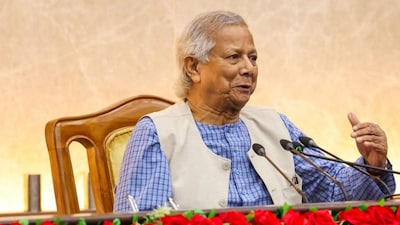
Outgoing Bangladesh chief adviser Muhammad Yunus invoked India’s northeastern “Seven Sisters” states alongside Nepal and Bhutan while outlining a sub-regional economic vision in his farewell speech, a formulation that may draw attention in New Delhi amid strained bilateral ties.
In a televised address delivered a day before stepping down, Yunus said Bangladesh’s foreign policy during his 18-month tenure restored three core pillars — sovereignty, national interest and dignity. He asserted that the country was “no longer submissive” or guided by the directives of other nations.
“Our open sea is not only a geographical boundary, it is an open door to engage with the world economy for Bangladesh. This region, along with Nepal, Bhutan and the Seven Sisters, has great economic potential,” Yunus said, referring to India’s northeastern states without directly naming India.
Proposal for Deeper Regional Cooperation
Yunus proposed strengthening sub-regional economic cooperation through enhanced connectivity, trade agreements, economic zones and expanded maritime access via Bangladesh. By grouping India’s northeastern states — an integral part of India — alongside sovereign nations, his remarks were seen by some observers as blurring established political distinctions.
The comments come at a sensitive time for India-Bangladesh relations, which have experienced strain in recent months.
Political Transition in Bangladesh
Yunus stepped down after a new government was elected, marking the end of his interim administration that took charge in August 2024 following the fall of the Sheikh Hasina-led regime.
The recent parliamentary elections saw the Bangladesh Nationalist Party (BNP) secure 209 of 297 seats. The party, headed by Tarique Rahman, is set to form the next government.
Foreign Policy and Strategic Balance
In his address, Yunus said his administration pursued a strategy of balanced diplomacy, expanding engagement with major global partners including China, Japan, the United States and Europe. He highlighted progress on Chinese-backed initiatives such as the Teesta River project and a hospital development project in Nilphamari.
He also referred to military modernisation efforts, stating that Bangladesh had begun strengthening its armed forces to counter potential aggression, without naming any specific country.
Governance and Domestic Criticism
Yunus noted that his administration framed around 130 new laws, amended several others and issued approximately 600 executive orders, with a majority already implemented. He defended agreements with international port management firms, despite worker protests, arguing that improved efficiency was critical for economic growth.
However, his tenure faced domestic criticism over minority safety, democratic transition management and foreign relations. Relations with India experienced a downturn, with New Delhi expressing concerns over reported attacks on minorities, particularly Hindus, and broader law-and-order issues.
Closing Message
In his final remarks, Yunus urged citizens to continue striving for a “just, humane and democratic Bangladesh,” expressing optimism about the country’s future. Before stepping down, he met senior bureaucrats and received a farewell call from Army chief Gen Waker-Uz-Zaman, thanking the armed forces for their cooperation during the election process.
His departure marks a new chapter in Bangladesh’s political landscape, with regional diplomacy and economic cooperation likely to remain key priorities for the incoming government.