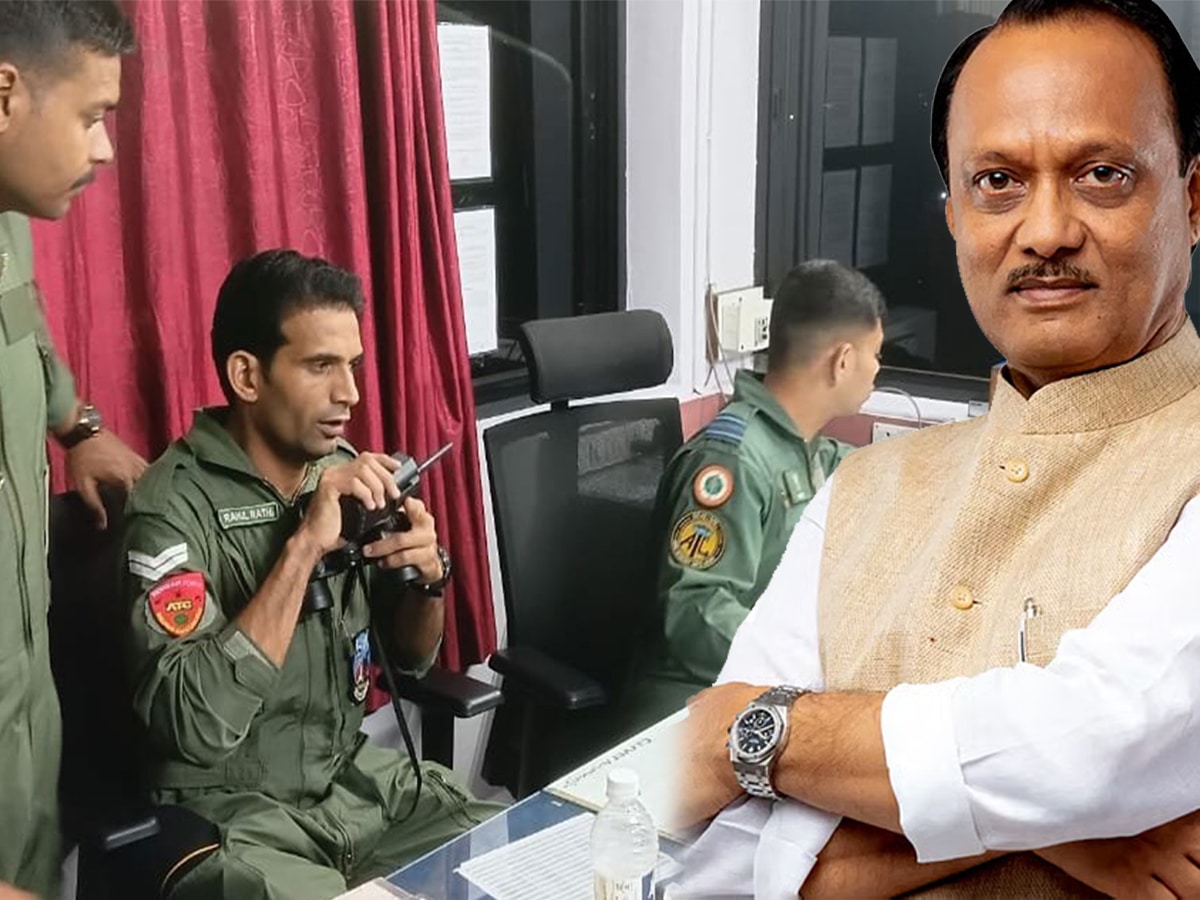
Following the fatal plane crash that claimed the life of Maharashtra Deputy Chief Minister Ajit Pawar and four others, the Indian Air Force (IAF) has deployed a team at Baramati airport to provide temporary air traffic control and meteorological support.
The move comes amid growing scrutiny of infrastructure gaps at the Baramati airstrip, which is classified as an “uncontrolled airport” and lacks several basic aviation safety facilities.
“This rapid assistance underscores the Indian Air Force’s commitment to national service in times of need,” the IAF said in a post on X.
What Does ‘Uncontrolled Airport’ Mean?
According to the Ministry of Civil Aviation, Baramati airport falls under Category A (uncontrolled) airports. These airfields do not have a dedicated Airports Authority of India (AAI)-run Air Traffic Control (ATC) service.
Instead, limited air traffic information services are provided by flying training organisations operating at the airport. At Baramati, this role is shared between Redbird Aviation and Carver Aviation, which manage the facility on alternate days.
At the time of Wednesday’s crash, a flight instructor from Carver Aviation was manning the ATC, confirmed Pramesh Parikh, the academy’s accountable manager.
Missing Safety Infrastructure at Baramati Airport
Aviation officials and experts have pointed to multiple shortcomings at the airport, including:
-
No full-time ATC tower
-
Absence of basic navigation aids such as PAPI and VOR
-
No independent meteorological facility
-
Limited emergency response infrastructure
The airport, constructed by the Maharashtra Industrial Development Corporation (MIDC) and inaugurated in 1996, typically sees only four to five aircraft movements per week, officials said.
No Dedicated Fire Tender, Narrow Runway
Airport in-charge Shivaji Taware said Baramati airport does not have a permanent fire tender. Ahead of Ajit Pawar’s arrival, a single fire tender from the Baramati Municipal Council had been stationed as a precaution.
“When the crash occurred, additional fire tenders were rushed in from the municipal council and MIDC,” Taware said.
Former Maharashtra aviation director Sanjay Karve noted that the runway is only 30 metres wide, significantly narrower than those at major airports. He also pointed to a shallow hump on the runway, which could distort a pilot’s visual perception during landing.
“In my opinion, this runway is not suitable for VIP operations,” Karve said.
No Navigation Aids, Reliance on Pune Weather Data
Experts also highlighted the absence of Precision Approach Path Indicator (PAPI) lights, which help pilots assess whether their approach is too high or too low. The airport also lacks a VOR (VHF Omnidirectional Range) beacon for navigation.
Baramati does not have its own meteorological unit and depends on weather data from Pune airport. On the day of the crash, officials said the region was covered in dense fog, with visibility reduced to around 3,000 metres.
Captain Naufil Karnalkar, who trained at Baramati, confirmed that visibility conditions were poor and said runway maintenance had not been adequately addressed.
Ajit Pawar Had Sought Airport Upgrade
As guardian minister of Pune district, Ajit Pawar had reportedly pushed for improvements at Baramati airport. Officials said he had held multiple meetings to fast-track upgrades.
“He had asked for basic facilities like PAPI lights, night-landing capability, and a regular ATC service,” said airport in-charge Shivaji Taware.
The airport was earlier managed by Reliance Airport Developers. The Maharashtra Airport Development Company (MADC) took over operations in August 2025 following what officials described as management lapses.
Crash Investigation Continues
The Learjet 45 aircraft crashed during its second landing attempt on Wednesday morning, killing all five people on board. The Aircraft Accident Investigation Bureau (AAIB) is conducting a detailed probe, with a focus on visibility, pilot decisions, and airfield limitations.