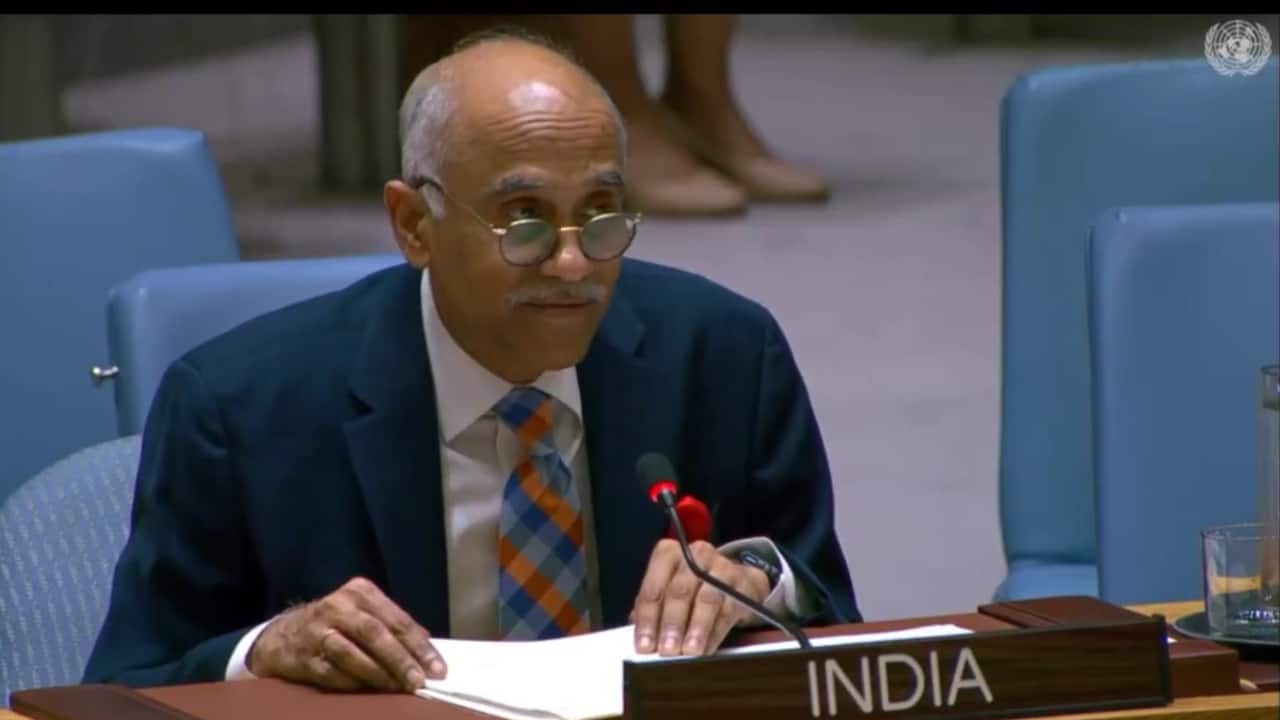
India’s Permanent Representative to the United Nations, Parvathaneni Harish, delivered a sharp rebuttal to Pakistan at the UN Security Council, rejecting what he described as Islamabad’s “false and self-serving” narrative on Operation Sindoor and accusing Pakistan of pursuing a singular agenda aimed at harming India and its citizens.
Harish was responding to remarks made by Pakistan’s UN envoy Asim Iftikhar Ahmad during a Security Council open debate on “Reaffirming International Rule of Law: Pathways to Reinvigorating Peace, Justice, and Multilateralism”. The Pakistani representative had referenced Operation Sindoor, Jammu and Kashmir, and the Indus Waters Treaty in his address.
“I now respond to the comments of the representative of Pakistan, an elected member of the Security Council, which has a single-point agenda to harm my country and my people. He has advanced a false and self-serving account of Operation Sindoor,” Harish said.
Operation Sindoor: India’s Response to Terror Attack
Operation Sindoor was launched by the Indian armed forces on May 7, 2025, following a terrorist attack in Pahalgam, Jammu and Kashmir, on April 22 that claimed 26 lives. According to Indian officials, the operation targeted nine terror camps in Pakistan and Pakistan-occupied Kashmir, resulting in the elimination of over 100 terrorists.
Rejecting Pakistan’s assertion that its response established a “new normal,” Harish stated that Pakistan continued to threaten further attacks until May 9, 2025.
“On May 10, the Pakistani military called our military directly and pleaded for a cessation to the fighting,” he told the Council.
He added that the damage inflicted on Pakistani military infrastructure — including destroyed runways and hangars — is already in the public domain.
No Legitimisation of Terrorism at the UN
The Indian envoy cautioned that the United Nations must not become a platform for legitimising terrorism.
“Tolerating Pakistan’s continued use of terrorism as an instrument of state policy is not normal,” Harish said, adding that Islamabad had no standing to comment on India’s internal affairs.
He reiterated that Jammu and Kashmir has been, is, and will always remain an integral and inalienable part of India.
Indus Waters Treaty and Terror Allegations
Addressing the Indus Waters Treaty, Harish said India entered the agreement 65 years ago in good faith, but Pakistan had repeatedly violated its spirit.
“Pakistan has inflicted three wars and thousands of terror attacks on India,” he said, noting that thousands of Indian lives have been lost in Pakistan-sponsored terrorism.
He explained that India was compelled to place the treaty in abeyance until Pakistan irreversibly ends all support for cross-border terrorism, describing the country as a “global epicentre of terror.”
Advice to Pakistan
Concluding his remarks, Harish urged Pakistan to reflect on its own adherence to the rule of law.
“Pakistan is well-advised to introspect,” he said, referring to the 27th Constitutional Amendment, which grants lifetime legal immunity to Pakistan’s Chief of Defence Forces, Field Marshal Asim Munir.
The amendment was passed in November last year under Prime Minister Shehbaz Sharif.