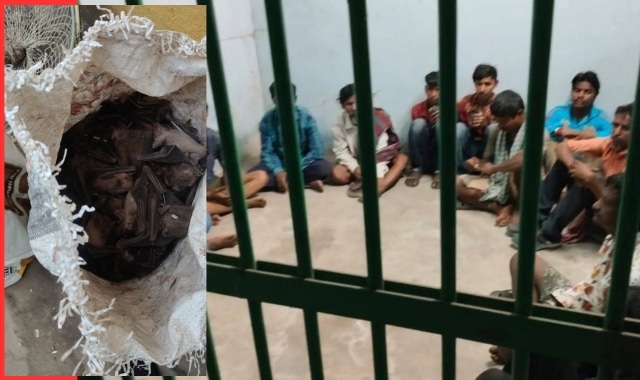
In a major crackdown on wildlife trafficking, forest officials in Odisha’s Athagarh division arrested 11 suspected poachers today, seizing over 800 dead bats packed into three sacks inside an abandoned timber factory.
The operation, triggered by a local tip-off, exposes a brazen poaching syndicate operating in the Khuntuni forest range, raising questions about a larger network and its elusive mastermind.
The raid unfolded near Kapursing village under the Khuntuni forest range, where poachers had turned a derelict sawmill into a makeshift slaughterhouse. Acting on intelligence about a long-running bat smuggling ring linked to jungle mafias, Range Officer Nilamadhaba Sahu mobilised his team and two additional forest squads. Locals, alerted by suspicious activity, had already surrounded the site and informed authorities, forcing the poachers into a hasty trap.
Upon storming the factory, officials discovered the gruesome scene: 11 men from various districts, armed with poaching gear, stuffing the bats into sacks for transport. The bats—a protected species under the Wildlife Protection Act—had been stunned using a chemical spray that rendered them unconscious mid-flight, allowing easy capture and slaughter. The poachers, all hailing from Bhubaneswar’s Salia Sahi area unless specified otherwise, include: Ram Sabar, Sekhar Sabar, Surya Sabar, Bapi Sabar, Abhaya Sabar, Ranjan Sabar, Ajay Sabar, Papu Sabar, Ashok Sabar, Babuli Nayak (from Pathar Bandh village under Shahid Nagar PS), and Deepak Sabar (from Managobindpur village under Danagadi PS in Jajpur district).
“We’ve been monitoring this gang for days. They target abandoned sites and forested areas, poaching rare bats for the black market,” said Nilamadhav Sahu, Divisional Forest Officer of Khuntuni. “The bats were destined for illegal sale, but we’re interrogating the suspects to uncover the full supply chain—who’s the kingpin pulling the strings, and where is this meat heading? Cases under the Wildlife Protection Act and animal cruelty laws will be filed, with court production tomorrow.”
The arrested poachers face rigorous questioning tonight, with officials probing deeper links to organised wildlife crime. Sources in the forest department revealed that the gang has been active for months, exploiting remote jungle spots and derelict factories around Bhubaneswar and beyond. Their operation was nearly foiled earlier due to lax oversight in the Athagarh division, which lacks a permanent Divisional Forest Officer—a gap critics say has emboldened such “jungle mafias.”
Environmental activists hailed the bust as a win for conservation but urged systemic reforms. “This is just the tip of the iceberg. Without permanent staffing and better patrols, poaching will thrive,” said a local wildlife advocate. The seized bats will be disposed of per protocol, while the investigation expands to dismantle the entire racket.
As Odisha grapples with rising wildlife threats, today’s arrests serve as a stark reminder of the fragile balance between human greed and nature’s bounty.