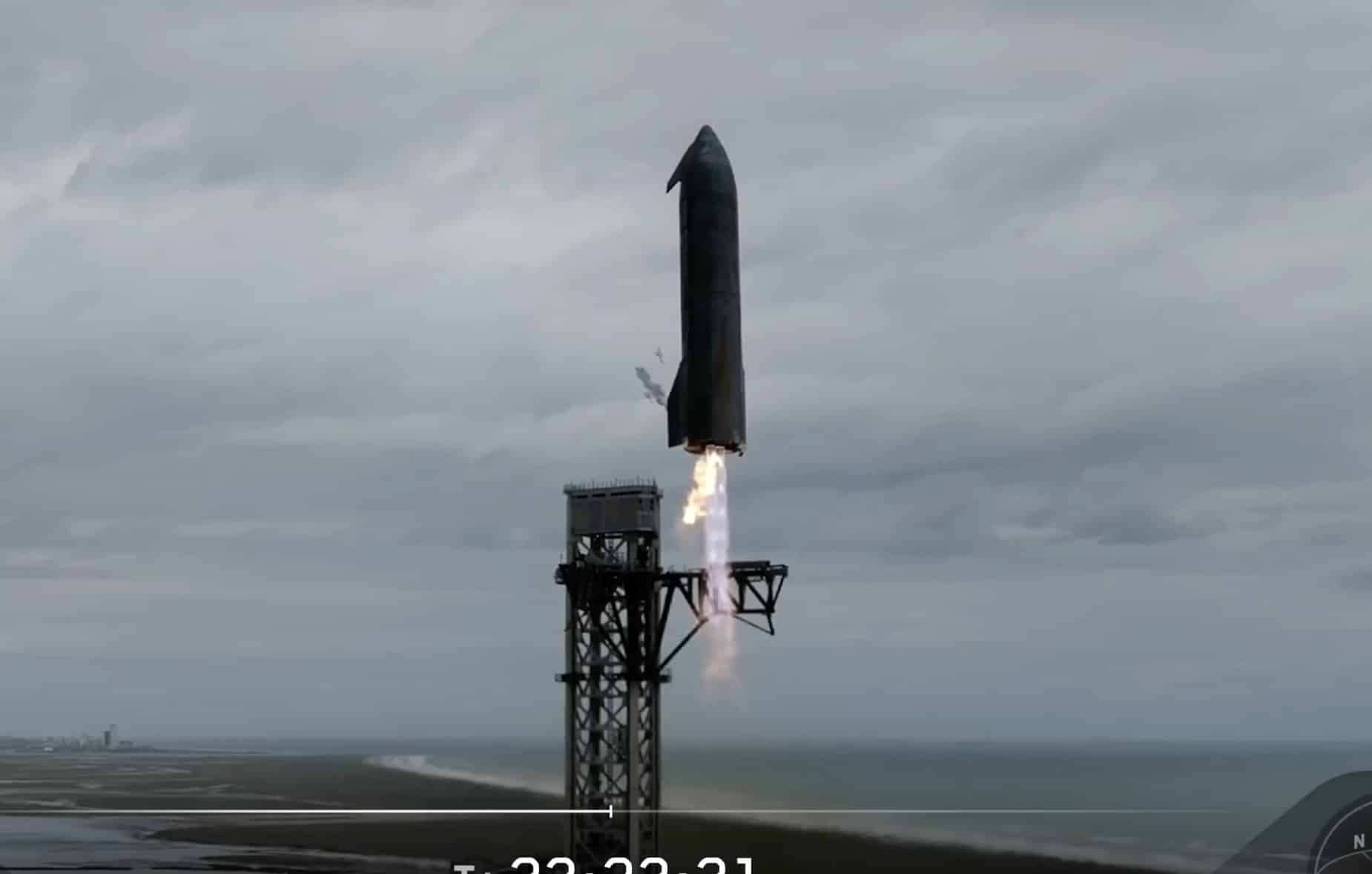
Elon Musk’s SpaceX achieved a landmark engineering breakthrough on Saturday, November 14, 2026, pulling off the first-ever midair “catch” of a returning Starship spacecraft using the giant mechanical “chopstick” arms on its launch tower in South Texas.
Concluding Starship’s 15th test flight (Flight 15), the upper-stage vessel survived the blistering heat of atmospheric re-entry, descended smoothly through a cloudy Texas sky, and nestled cleanly between the steel arms above Launch Pad 2 at Starbase—roughly 22 hours after lifting off.
Why Catching the Starship Upper Stage Is a Spaceflight Milestone
While SpaceX had previously captured returning Super Heavy boosters three times, recovering the Starship upper stage represents a far tougher engineering feat because the spacecraft travels higher, farther, and re-enters at much greater speeds from orbit:
-
- 22-Hour Orbital Mission & Starlink Deployment: During Flight 15, the Starship upper stage orbited Earth 14 times and deployed 26 next-generation Starlink V3 satellites before executing a carefully mapped descent over sparsely populated desert terrain and looping around Texas’s Rio Grande Valley in a “giant swoosh maneuver” to approach the pad from the east.
- NASA & Industry Praise: SpaceX founder Elon Musk congratulated teams and shared footage of the vessel suspended in the tower arms, noting it “looks great!” Meanwhile, NASA Administrator Jared Isaacman hailed the recovery as “almost magic” and “one step closer” to returning astronauts to the Moon under the Artemis lunar lander program.
- Remaining Engineering Hurdles: Aerospace analysts—including CSIS expert Clayton Swope and Georgetown University’s Kathleen Curlee—praised the breakthrough as proof that full reusability works, while noting SpaceX must demonstrate repeated catches and master in-orbit propellant transfer for deep-space Moon and Mars missions. On Friday’s ascent, the mission’s Super Heavy booster aborted its own tower catch attempt and diverted to the Gulf of Mexico due to a technical issue.
”That was the Holy Grail of spaceflight, plummeting through fire to be snatched out of the air by steel. We caught a Starship and now, everything changes.”
— Dan Huot, SpaceX Spokesman
Scaling Production After Record IPO
The milestone comes months after SpaceX’s high-profile June 2026 stock market debut raised roughly $85.7 billion, fuelling rapid infrastructure expansion. Ahead of the flight, company officials revealed that SpaceX’s million-square-foot Starbase factory can now produce a new Starship upper stage every two weeks and a Super Heavy booster every four weeks as it works toward Musk’s long-term vision of rapid, high-frequency orbital launches.