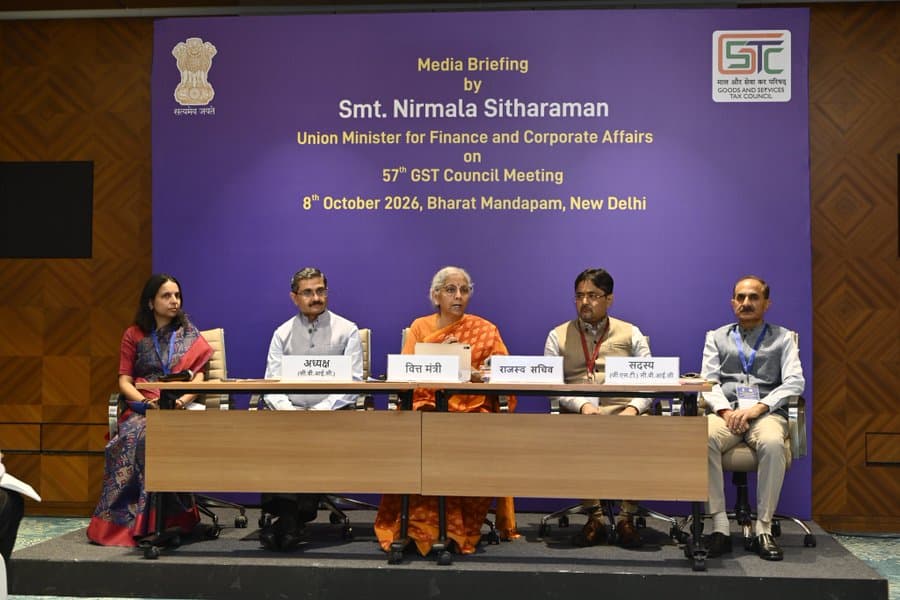
The 57th GST Council meeting, chaired by Union Finance Minister Nirmala Sitharaman in New Delhi on 8 October 2026, advanced a set of practical reforms aimed at making the tax system simpler, faster and more predictable for businesses.
Chief Ministers, Finance Ministers and nominated ministers from states and Union Territories joined senior central and state officials for the session. Representing Odisha’s Chief Minister Mohan Charan Majhi, Cabinet Minister Prithviraj Harichandan (Law, Works and Excise) outlined the state’s priorities on compliance relief and process improvements.
Discussions centred on measures that support economic growth and the broader goal of Viksit Bharat by 2047. A core proposal is system-based processing and sanction of refunds so that genuine taxpayers receive money faster and with clearer visibility. The Council also considered allowing refund of input tax credit (ITC) on capital goods used for zero-rated supplies, plus ITC on input services and capital goods under the inverted duty structure. Both changes are expected to free working capital for exporters and manufacturers.
Registration simplification received attention as well. Clearer guidelines and practical tools are intended to help small businesses and taxpayers in rural and semi-urban areas complete the process with fewer hurdles. Recommendations from the Working Group on GST Returns and Processes—an exercise in which the Odisha State GST team participated—cover return filing and an alternative route for correcting liabilities and ITC. The aim is to cut mismatches that currently trigger unnecessary notices. Odisha officials also contributed to process-based refund reforms through the GST Law Committee.
Another proposal would remove arrest provisions for economic offences that can already be addressed adequately under existing GST law, seeking a clearer balance between enforcement and taxpayer confidence.
Taken together, the measures are designed to improve ease of doing business and ease of compliance. For MSMEs and small firms in Odisha and elsewhere, the changes are expected to reduce procedural friction so that owners can spend more time on operations and expansion rather than paperwork and follow-ups. The Council’s direction signals a continued shift toward a more transparent and responsive GST regime.