
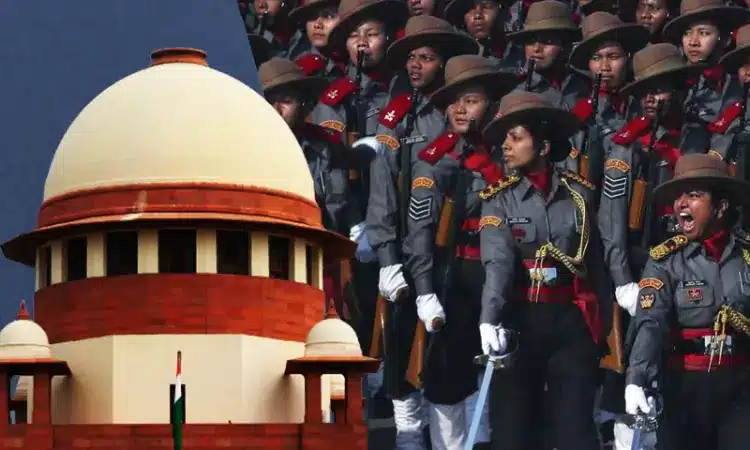
In a landmark decision, the Supreme Court has ruled that women Short Service Commission (SSC) officers in the Indian Armed Forces who were released after 14 years of service will now be entitled to pension benefits. The ruling applies as a one-time relief measure and marks a significant step toward addressing long-standing concerns over gender parity in military service conditions.
Under existing rules, personnel are required to complete 20 years of service to qualify for pension. However, invoking its extraordinary powers, the court directed that eligible women officers be deemed to have completed the required 20 years of qualifying service.
The judgment covers women officers from the Army, Navy, and Air Force who were considered for Permanent Commission (PC) but were denied the opportunity. The court stated that these officers should not be disadvantaged due to systemic and procedural limitations in earlier policies.
Key Observations by the Court
The bench highlighted critical flaws in the evaluation process under the 2019 Human Resource Policy, noting that performance benchmarks were introduced without providing officers sufficient time to adapt.
Women officers inducted under SSC in 2007 were assessed for Permanent Commission during selection boards held between 2019 and 2021. However, many were released from service in 2021 after being deemed ineligible under revised criteria.
The court observed that:
- The sudden introduction of new performance standards was unfair
- Officers were not given adequate time or opportunity to meet revised benchmarks
- Service length should not have been treated as a disqualifying factor
Pension Relief and Conditions
As per the ruling:
- Eligible officers will be treated as having completed 20 years of service
- They will receive pension and related benefits accordingly
- The pension entitlement will take effect from November 1, 2025
- No arrears of pay will be granted
Additionally, officers currently serving will be eligible for Permanent Commission subject to meeting criteria such as performance grading, medical fitness, vigilance clearance, and disciplinary standards.
Significance of the Verdict
The decision is being viewed as a major corrective step in ensuring fairness and inclusivity within the armed forces. It acknowledges the structural challenges faced by women officers and provides long-overdue financial security to those affected.
Legal experts believe the ruling reinforces the judiciary’s role in upholding equal opportunity and addressing institutional gaps, especially in sectors traditionally dominated by rigid service frameworks.
Conclusion
The Supreme Court’s directive not only offers financial relief but also sends a strong message on gender equity in defence services. While the relief is limited to a specific group and timeframe, it sets an important precedent for future policy considerations in the armed forces.