When severe cyclones or floods sweep across Odisha’s coastline, downed power lines often plunge entire blocks into darkness for days. For communities crowded into Multipurpose Disaster Shelters (MDSs), losing electricity means losing lighting, clean water pumping, phone charging, and vital communication links right when emergency response matters most.
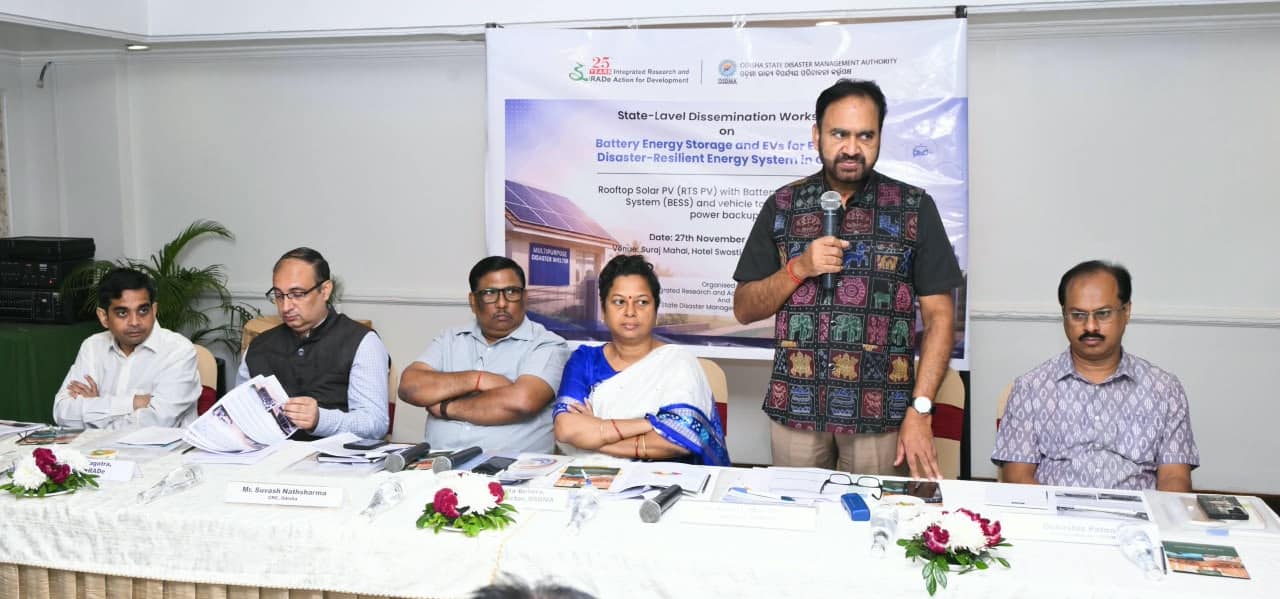
To build cleaner, tougher power backups for these frontline facilities, the Odisha State Disaster Management Authority (OSDMA), in collaboration with Integrated Research and Action for Development (IRADe), hosted a State-Level Dissemination Workshop on “Battery Energy Storage and EVs for Enabling Disaster-Resilient Energy Systems in Odisha.” Rooted in OSDMA’s vision of a Disaster-Resilient Odisha, the gathering brought policymakers, researchers, clean-tech developers, and local stakeholders together to review pilot findings and map out how decentralised energy can keep shelters running during crises.
Two Puri Pilots Show How Solar and Storage Perform
Under the initiative, IRADe carried out a techno-economic feasibility assessment and set up pilot solar hybrid power systems with Battery Energy Storage Systems (BESS) at two Multipurpose Disaster Shelters in Puri district: Narsinghpatana in Brahmagiri block and Keutajanga in Astaranga block. Each pilot features a 3 kWp solar hybrid setup paired with battery storage, backed on the ground by OSDMA, the Puri District Disaster Management Authority (DDMA), and local block administrations.
Presenting the feasibility study, Dr. Probal Ghosh, Deputy Director at IRADe, noted that well-engineered solar PV and battery storage systems can curb reliance on grid electricity and diesel generators while delivering steadier power. Depending on system sizing, battery capacity, critical loads, and vehicle availability, select stationary battery configurations can keep essential shelter loads running for more than 24 hours during extended grid outages.
Crucially, the systems are not idle waiting for a storm. During normal days, they can lower grid power draw and cut operating costs, giving authorities a practical financial and technical case for tailoring setups to different shelter needs.

Leadership Calls for Scaling Across More Than 800 Shelters
Odisha operates more than 800 Multipurpose Disaster Shelters and school-cum-shelters statewide, making the coastal pilots a testbed for wider rollout in cyclone- and flood-prone districts. Lessons from Narsinghpatana and Keutajanga have helped shape technical standards, risk-informed designs, critical-load profiles, financing models, and operation-and-maintenance routines for broader adoption.
Sushmita Behra, Executive Director, OSDMA, thanked IRADe for partnering on the first-of-its-kind solar PV and battery storage deployment for disaster shelters and noted strong potential to scale the model across other shelters in Odisha using insights from the pilots.
Dr. Kamal Lochan Mishra, Advisor, OSDMA, called the project a meaningful step toward weaving clean energy into disaster risk management. Pairing renewables, battery storage, and complementary backup options, he said, moves Odisha toward more energy-secure, operationally resilient, and future-ready shelters aligned with the state’s disaster-resilience vision.
Rohit Magotra, Director, IRADe, stressed blending conventional and emerging technologies to strengthen both energy and disaster resilience, adding that pilot learnings will guide community-managed clean energy systems at shelters.
Building a Coalition for Scale
Beyond technical presentations, the workshop served as a working forum for officials from the Energy Department, state renewable energy agencies, DISCOMs, Village Level Disaster Shelter Management Committees, solar PV developers, battery makers, think tanks, and civil society. Participants examined the technical, financial, institutional, and policy steps needed to move from pilots to scale.
Speakers underscored that lasting impact will depend on tight coordination across government departments, alignment with existing schemes and financing channels, and hands-on local training so communities can operate and maintain the systems reliably—ensuring that when the next storm hits, Odisha’s shelters stay powered and ready.