The Odisha government has strengthened its early warning mechanisms and rolled out wider interventions to curb lightning-related fatalities and property damage across the state.
According to Revenue and Disaster Management Minister Suresh Pujari, timely pre-alert systems have driven a notable decline in deaths despite rising lightning frequency and intensity linked to climate change.
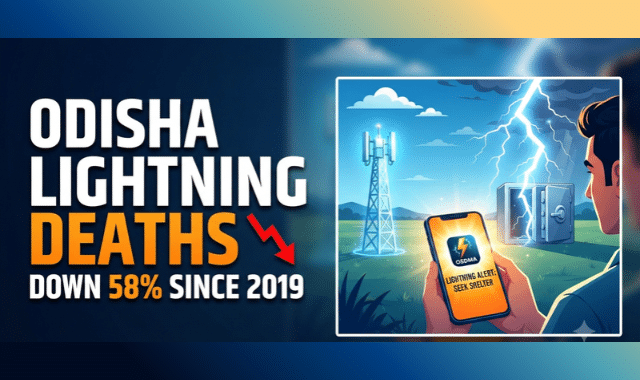
Official figures show lightning fatalities in Odisha dropped from 350 in 2019–20 to 143 in 2024–25 and 147 in 2025–26. Recognising the severity of the hazard, the central government has classified lightning as a state-specific disaster and approved ex-gratia assistance of ₹4.00 lakh for the next of kin of each deceased person.
To improve forecast accuracy and lead times, the state is working with national scientific bodies to deploy advanced technology. Through the Common Alerting Protocol (CAP) implemented by the National Disaster Management Authority (NDMA), residents receive SMS and cell broadcast alerts for cyclones, floods, and lightning. The Odisha State Disaster Management Authority (OSDMA) also issues advance warnings via the ‘Satark’ mobile application.
To sharpen these efforts further, OSDMA hosted a national-level workshop in Bhubaneswar from October 14 to 16, 2026. Specialists from Fakir Mohan University, NRSC, IIT Bhubaneswar, IITM Pune, and the India Meteorological Department (IMD) participated and shared recommendations.
Responding to a query from MLA Raja Swain, the minister added that with NDMA support, lightning detection and warning systems (‘MPLAS’) are being implemented across five high-risk districts: Mayurbhanj, Ganjam, Baleshwar, Kendujhar, and Kataka.