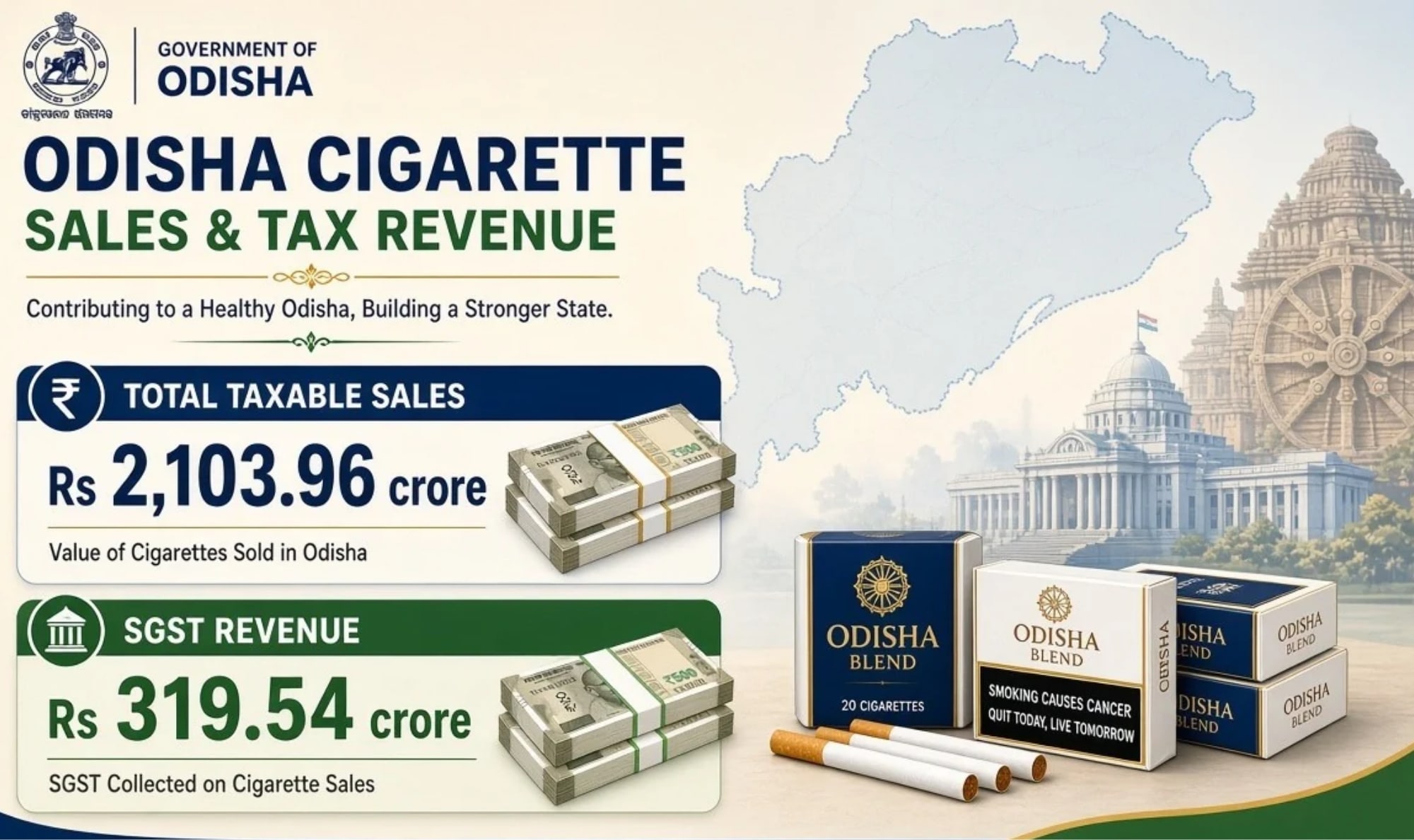
Odisha recorded cigarette sales worth a massive Rs 2,103.96 crore in total taxable value during the 2025–26 financial year, generating Rs 319.54 crore in State Goods and Services Tax (SGST) for the state exchequer, Chief Minister Mohan Charan Majhi informed the Odisha Legislative Assembly.
Responding in writing to a query raised by Sonpur MLA Niranjan Pujari, the Chief Minister laid out detailed taxpayer-wise figures for cigarette sales and the corresponding tax collections. According to the official data tabled in the House, the exact taxable value of cigarette sales stood at Rs 2,103,96,86,686, translating into an SGST collection of Rs 3,19,54,13,042 for FY 2025–26.
Major Overhaul in Tobacco Taxation
Beyond the annual revenue figures, Majhi highlighted a structural shift in how cigarettes are taxed across the state and country. Since the rollout of GST on July 1, 2017—which replaced the erstwhile Value Added Tax (VAT) system—cigarettes were taxed at 28 per cent (split equally into 14 per cent SGST and 14 per cent CGST), alongside an applicable GST Compensation Cess.
However, acting on the recommendations of the 56th GST Council meeting, the tax framework underwent a major revision effective February 1, 2026:
-
Higher Base GST: The total GST rate on cigarettes was raised from 28 per cent to 40 per cent (20 per cent SGST and 20 per cent CGST).
-
Zero Compensation Cess: The additional GST Compensation Cess was simultaneously brought down to zero.
-
Central Levies: Majhi noted that the Central Government continues to levy Central Excise Duty—comprising Basic Excise Duty and National Calamity Contingent Duty (NCCD)—exercising its exclusive constitutional authority under Entry 84 of the Union List.
The Chief Minister also clarified that because cigarettes are tracked under HSN Code 2402, tax records are maintained strictly by HSN classification rather than by individual cigarette brands.
Shifting the Tax Burden to Plug Revenue Leaks
A cornerstone of the revised February 2026 framework is the transition to taxing cigarettes based on their Retail Sale Price (RSP)—the maximum all-inclusive price printed on the packet—while shifting the primary tax collection responsibility directly onto the manufacturer.
Explaining how the mechanism prevents tax evasion at the retail end, Majhi illustrated the math using a cigarette pack priced at an RSP of Rs 20:
-
Calculation: Using the formula $\text{GST} = \frac{\text{RSP} \times 40}{100 + 40}$, the 40 per cent GST component on a Rs 20 pack comes to Rs 5.71.
-
Manufacturer Stage: The manufacturer collects and deposits this entire Rs 5.71 with the government during the very first sale to the distributor.
-
Distributor Stage: The distributor claims this Rs 5.71 as Input Tax Credit (ITC). When selling the pack onward to the retailer at the same Rs 20 RSP, the distributor’s Rs 5.71 output tax liability cancels out completely against their ITC, resulting in zero additional net tax payment downstream.
By locking in tax collection at the initial manufacturing stage of the supply chain, the state government expects significantly stronger compliance and minimal revenue leakage going forward.