Odisha has received Rs. 78,54,924 (around Rs. 78.55 lakh), as the National Biodiversity Authority (NBA) disbursed a total of Rs. 13.76 crore (Rs. 13,76,01,172) in Access and Benefit Sharing (ABS) funds across 28 States and 4 Union Territories.
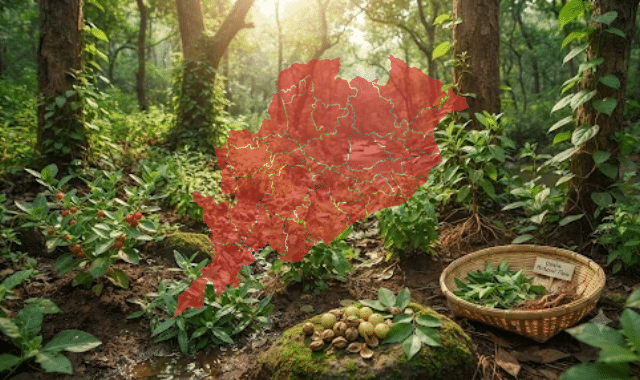
Placed sixth among all states and territories, Odisha’s share reflects its substantial forest cover and rich presence of medicinal plant species.
The funds come from ABS contributions paid by AYUSH product manufacturing companies for the commercial use of medicinal plants and other plant-based biological resources. The latest disbursement covers three applications involving 234 plant species. Because these resources moved through broader market and trader networks rather than traceable individual claimers, allocations were determined using state forest cover and the occurrence of medicinal plants in each region.
Ten high-impact species—Guggul, Ashwagandha, Bhringraj, Punarnava, Sarpagandha, Kalmegh, Black Pepper, Indian Gooseberry, Gokhura, and Shalparni—account for Rs. 6.45 crore of the overall Rs. 13.76 crore payout. Nationally, Maharashtra topped the list with Rs. 1,75,24,129, followed by Arunachal Pradesh (Rs. 93,74,889), Andhra Pradesh (Rs. 88,07,925), Karnataka (Rs. 87,14,794), and Kerala (Rs. 79,30,040), just ahead of Odisha.
For Odisha, where forest ecosystems and traditional healing knowledge are closely intertwined with rural life, the ABS funds open avenues to strengthen local biodiversity governance. They can support Biodiversity Management Committees (BMCs), help update People’s Biodiversity Registers (PBRs), and fund documentation of biological resources and traditional knowledge. The resources can also go toward research, capacity building, community-led conservation, restoration of degraded ecosystems, sustainable harvesting and cultivation, and biodiversity-based livelihoods.
Across India, the NBA has collected Rs. 278 crore under the ABS mechanism so far and disbursed around Rs. 218.86 crore for biodiversity conservation and benefit-sharing initiatives. Officials note that the framework aligns with the Kunming-Montreal Global Biodiversity Framework (KMGBF)—specifically Target 13 on fair and equitable benefit sharing—and the Yerevan Pathway adopted at CBD COP 17 (held from October 19 to 30, 2026).
These payouts also complement schemes such as the National AYUSH Mission, National Medicinal Plants Board programmes, and the Pradhan Mantri Van Dhan Yojana, reinforcing efforts to pair medicinal plant stewardship with sustainable income generation for forest-dependent communities.