Researchers at the National Institute of Technology (NIT) Rourkela have developed a breakthrough electrochemical technology capable of transforming human urine into struvite, a high-value, slow-release agricultural fertiliser.
Published in the prestigious Journal of Water Process Engineering, the innovation offers a sustainable, circular-economy solution to tackle wastewater management while reducing agriculture’s heavy reliance on energy-intensive commercial fertilisers.
Phosphorus and nitrogen are foundational to modern farming as core ingredients in Nitrogen-Phosphorus-Potassium (NPK) fertilisers. While human urine is naturally rich in both nutrients, traditional methods of extracting them rely on chemical precipitation. This conventional approach requires a continuous, costly supply of alkaline chemicals and external magnesium salts, making large-scale adoption economically challenging.
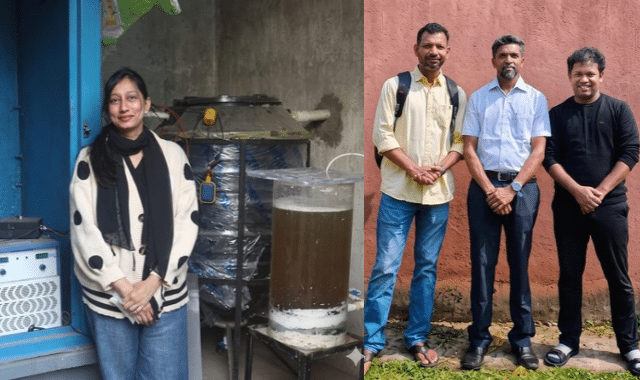
To bypass these chemical bottlenecks, the NIT Rourkela research team—comprising Associate Professors Prof. P. Balasubramanian and Prof. Sivaraman J., Assistant Professor Prof. Bikash Chandra Maharaj, and Research Scholar Ms. Alisha Zaffar from the Department of Biotechnology and Medical Engineering—designed an electricity-driven alternative.
Instead of adding external salts, the system passes an electric current through urine using sacrificial magnesium electrodes. As the electrodes gradually dissolve, they release magnesium ions directly into the liquid, reacting with the naturally present phosphorus and nitrogen to form pure struvite crystals.
“Our electrochemical process offers a sustainable and chemical-free route for nutrient recovery,” explained Prof. P. Balasubramanian. “By using a sacrificial magnesium anode, we can generate the required magnesium ions in situ, eliminating the need for external chemical addition and enabling precise control over the precipitation process. This makes the technology compact, modular, and well-suited for decentralised nutrient recovery.”
Overcoming Technical Hurdles
A common roadblock in electrochemical systems is sludge buildup on the electrodes, which blocks electrical flow and degrades efficiency. The NIT Rourkela team solved this by integrating a “reverse polarisation” technique—periodically flipping the direction of the electric current to self-clean the electrodes and ensure steady, uniform magnesium dissolution.
Testing the technology on urine collected from male urinals across 5-litre and 35-litre reactors, the researchers achieved remarkable results:
- Over 98% phosphorus recovery in the 5-litre laboratory reactor.
- More than 91% recovery in the scaled-up 35-litre system.
Advanced X-ray diffraction (XRD) and Fourier-transform infrared spectroscopy (FTIR) confirmed the output was pure struvite. When put to the test on crops, the urine-derived fertiliser matched the performance of commercial NPK fertilisers in growing basil, cowpea, and okra.
Scaling for Economic Viability
Beyond laboratory success, the team evaluated the commercial feasibility of the technology. Prof. Balasubramanian noted that while standalone struvite recovery in a 35-litre unit carries high operating costs, integrating it with secondary processes—such as recovering ammonium sulphate—unlocks strong profitability.
Modelled at a 500-litre pilot scale, this multi-nutrient approach proved financially viable, projecting a payback period of 6.55 years and an internal rate of return (IRR) of 13%.
Looking ahead, the researchers plan to conduct open-field agricultural trials, develop continuous-flow systems, and upgrade the reactors to simultaneously capture green hydrogen—turning everyday sanitation infrastructure into decentralised hubs for both clean energy and sustainable farming.