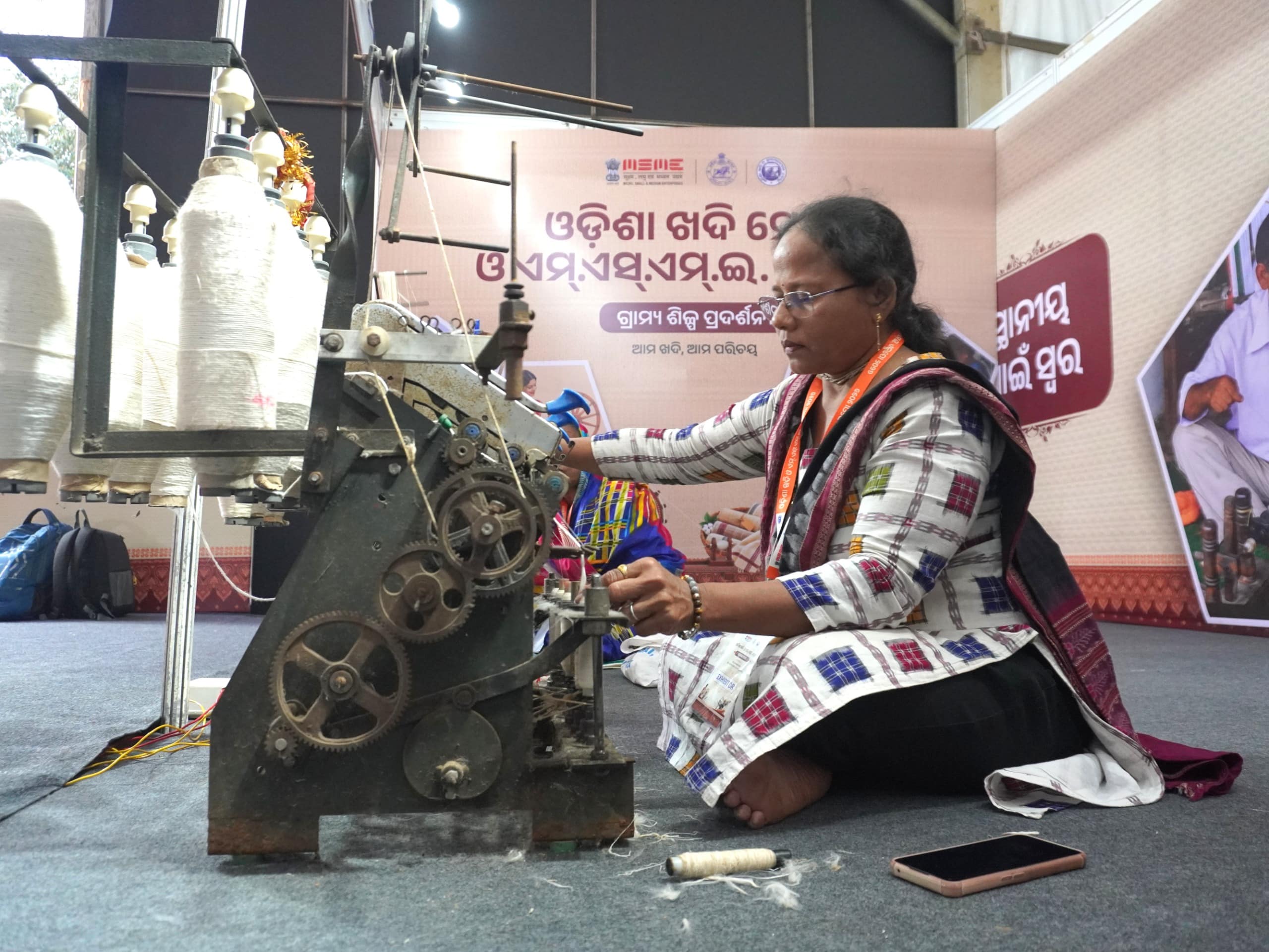
When personal tragedy strikes, many are left searching for footing. Others turn sorrow into purpose—lighting a path forward for themselves and dozens of others. Mahamaya Tejani belongs to the latter.
Having lost her husband just five years into marriage, she refused to let hardship break her resolve. Instead, she dedicated her life to preserving a three-generation family khadi tradition and building livelihoods for rural women.
Her stall at the Odisha Khadi & MSME Expo 2026 stands out not only for its craftsmanship, but for the quiet determination behind it.
Roots in the Swadeshi Movement
Mahamaya’s commitment to khadi traces back to her grandfather, Harekrisna Biswal, widely remembered as “Balikuda Gandhi.” Deeply moved by Mahatma Gandhi’s call for self-reliance during the freedom struggle, he devoted himself to khadi work and passed those Swadeshi values on to his son, Pratap Keshari Biswal.
Years later, that family heritage faced a critical test. As Pratap Keshari lay bedridden battling cancer and unable to speak, he gestured silently to his daughter Mahamaya, asking her to keep the khadi work alive.
Recalling that moment with tear-filled eyes, Mahamaya said her father’s unspoken request changed the course of her life. “I didn’t even know the ‘Kha’ of khadi,” she shared, “yet I embraced khadi work as my responsibility and an integral part of my life.”

Building Livelihoods Through Khadi Udyog Mandir
To give structure and scale to her mission, Mahamaya established Khadi Udyog Mandir, turning an inherited legacy into a hub of women’s employment.
At the organisation:
- 15 women spin yarn
- 10 weavers craft cloth on looms
- 20 women stitch garments on sewing machines
Their work received a further boost when the Khadi and Village Industries Board provided 20 sewing machines under the PM Vishwakarma scheme, helping strengthen production capacity.
A Living Legacy of Self-Reliance
Mahamaya’s journey is more than the preservation of a family craft—it is a practical continuation of Gandhi’s Swadeshi vision in contemporary Odisha. By setting aside personal grief and creating steady work for fellow women, she has built a model of self-reliance rooted in care and perseverance.
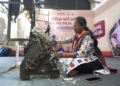
The charkha that once turned in her grandfather’s hands now carries a renewed purpose in hers—a story of resilience, family values, and economic independence that resonates far beyond the expo floor.