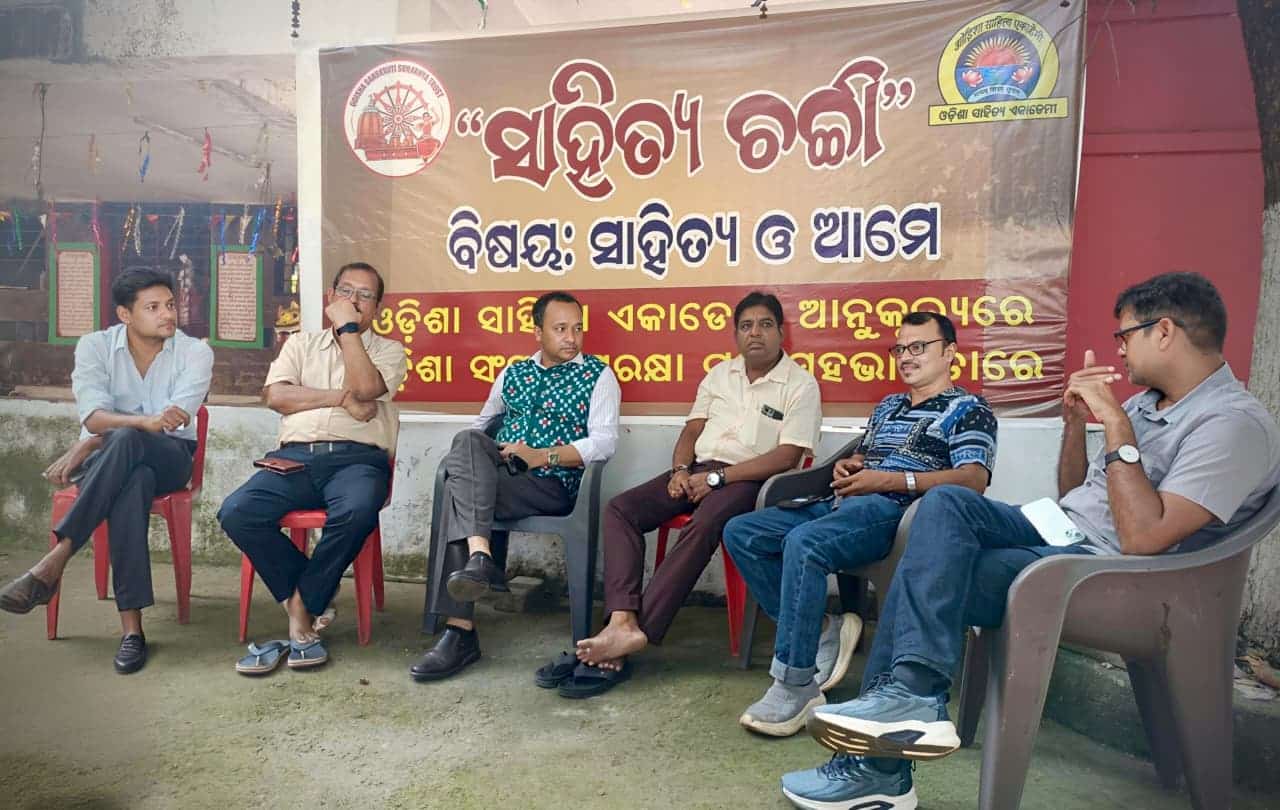
In a rapidly evolving society, literature continues to play a decisive role, yet a pressing question remains: how well are those associated with literature adapting to changing times? This thought-provoking query took centre stage on Sunday at a literary symposium titled ‘Sahitya O Aame’ (Literature and Us), held on the premises of the Talapadeswari Temple at Vani Vihar here.
Jointly organised by the Odisha Sahitya Akademi and the Odisha Sanskruti Surakhya Trust, the event was presided over by social worker Dr Prakash Tripathy and drew a vibrant gathering of litterateurs, linguists, columnists, journalists, and social activists.
Addressing the gathering as an esteemed speaker, sociologist and columnist Dr Abash Parida explored the psychological landscape of contemporary writers and the prevalence of the “Matthew Effect” within literary circles. Acknowledging that public interest in literature has waned in the digital era, Dr Parida noted that significant opportunities still lie ahead for translation, children’s literature, and essay writing.
Speaking on the intersection of ‘Literature and Journalism,’ senior journalist Choudhury Amitav Das urged the younger generation to embrace technological advancements without abandoning books. “Everything today is moving forward with technology, and we must adopt it. However, alongside using technology, we must read more books—only then will our work truly shine,” Das remarked. Pointing out that declining reading habits have dulled creative brilliance, he encouraged aspiring writers and journalists to read extensively, master language and literature, and innovate in their craft to prove their relevance and keep literature alive.
Echoing the need for generational renewal, senior litterateur Dr Chakradhar Das stressed that literary discussions must actively involve young writers. Observing a noticeable dip in both passionate writers and eager readers compared to the past, Dr Das asserted that Odia literature can only flourish if youth step forward to take the mantle.
Other prominent voices also shared their perspectives during the session.
Harihar Panda, journalist and writer, noted that literature is embedded in every human action and will endure as long as humanity exists, adding that every journalist creates literature on a daily basis.
Ramajibana Gochhayat, senior journalist, described literature as an unstoppable current and urged everyone to stay connected to its flow.
Rajat Rashmi Swain, publisher and litterateur, reflected on his personal journey from being a writer to a journalist and eventually a publisher, offering insights into the evolving literary ecosystem.
The symposium concluded with a collective consensus that literature should not remain confined to the pages of books, but rather act as a catalyst for social transformation, human values, and self-awareness.