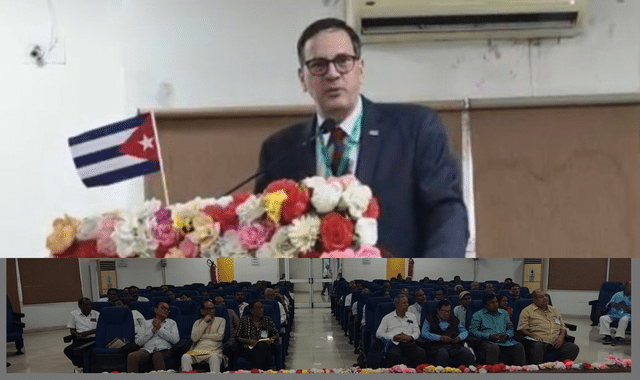
The Indian Society for Cultural Co-operation and Friendship (ISCUF) marked its 85th Foundation Day on Friday with a packed programme at Geetagovinda Sadan in Bhubaneswar, mixing diplomacy, debate and theatre around a single theme: friendship across borders and peace at home.
Cuba’s Ambassador to India, Juan Carlos Marsán, attended as chief guest. ISCUF president Bhanudeb Dutta inaugurated the celebration. Speakers returned again and again to the organisation’s founding purpose — people-to-people friendship, world peace, and the defence of India’s unity in diversity.
That mission has a long paper trail. ISCUF began in 1941 as the Friends of the Soviet Union and later became the Indo-Soviet Cultural Society. After the Soviet collapse it recast itself, in 1993, as a broader friendship body. Friday’s speeches stressed that the old “friendship movement” now reaches well beyond its Soviet-era origins to Cuba, China, Vietnam and other countries described as peace-seeking and democratic.
The day opened at 10 a.m. with a delegates’ session chaired by Justice Manoranjan Mohanty. In the afternoon, a cultural slot featured the play *Dimagi Naxal*. Later came a panel discussion titled “A Call for World Peace and Democracy,” with Professor Manas Behera among the speakers.
The guest list reflected ISCUF’s Odisha network as much as its national one. Among those present were politician and social worker Niranjan Pattnaik, Prafulla Chandra Ghadei, Ranendra Pratap Swain, Shashi Bhushan Behera, Prashant Muduli, Sarada Jena, Dr Prashant Mishra, and ISCUF all-India general secretary Bijay Kumar Padhihari.
For an organisation born in wartime solidarity and later tied to Indo-Soviet cultural diplomacy, the Bhubaneswar event was less a museum piece than a claim of continuity: that cultural friendship still has work to do, and that Odisha remains one of the places where that work is staged in public.