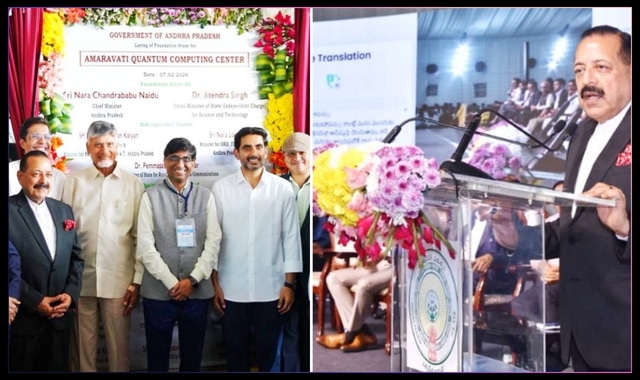
In a landmark move signalling India’s ambitious stride into the quantum era, Union Minister Dr Jitendra Singh today laid the foundation stone for the Amaravati Quantum Centre in Andhra Pradesh, heralding it as the “foundation stone of India’s quantum future.”
The event marks a pivotal chapter in the ₹6,000 crore National Quantum Mission, positioning India among an elite group of nations advancing quantum technologies for defence, cybersecurity, healthcare, and beyond.
Speaking at the ceremony in Amaravati, Dr Singh emphasised that quantum technology is no longer an option but a strategic imperative for India’s security and innovation. “India has no choice but to lead in this domain if it seeks to secure its communication systems, defence architecture, healthcare innovation, and global technological standing,” he stated. The minister highlighted the mission’s goals, including developing quantum computers with up to 1,000 physical qubits within eight years and establishing a 2,000 km inter-city Quantum Key Distribution network for secure communications.
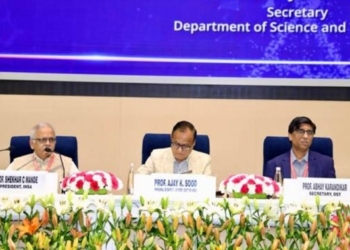
The foundation ceremony was a high-profile affair, attended by Andhra Pradesh Chief Minister N. Chandrababu Naidu, IT and Electronics Minister Nara Lokesh, Principal Scientific Adviser Prof. Ajay Kumar Sood, DST Secretary Prof. Abhay Karandikar, IIT Madras Director Prof. V. Kamakoti, and industry stalwarts such as Dr. Amit Singhee from IBM Research India, Dr. Harrick Vin from TCS, and M. V. Satish from L&T. The gathering underscored a collaborative “whole-of-government, whole-of-nation” approach, with key announcements including the launch of the Amaravati Quantum Valley logo, IBM and TCS Quantum Cloud Services, an IBM-TCS Quantum Innovation Centre, a Quantum Talent Hub, SRM University’s Quantum Reference Facility, and a Quantum-Safe Applications initiative. Multiple MoUs were exchanged with nine industry partners, fostering ties between government, academia, and the private sector.
Dr Singh praised CM Naidu’s visionary leadership, calling him a pioneer who “lives in tomorrow and dreams of the day after tomorrow.” He recalled Naidu’s early tech initiatives in Hyderabad’s Hi-Tech City and noted the rapid progress in Andhra Pradesh under the current administration, exemplifying Prime Minister Narendra Modi’s “double-engine” model of cooperative federalism. The minister also referenced his recent visit to Visakhapatnam, where a long-stalled National Centre for Ocean Sciences was swiftly completed, bolstering India’s Deep Ocean Mission and Blue Economy goals.
The National Quantum Mission, spanning 43 institutions across 17 states and 2 Union Territories, is structured around four thematic hubs: Quantum Computing, Quantum Communication, Quantum Sensing and Metrology, and Quantum Materials and Devices. Dr Singh addressed students at the event, explaining quantum’s transformative potential. He noted that quantum encryption could render data breaches nearly impossible, offering unbreakable security in a vulnerable digital world. In healthcare, it promises precision therapies like targeted radiation for tumours, minimising damage to healthy tissues. Defence applications include advanced satellite communications and sensing, while cybersecurity gains from impenetrable networks.
Reflecting on India’s tech trajectory, Dr Singh asserted that while the country entered the IT revolution late, it won’t lag in quantum or other emerging fields like AI, biotechnology, space, and deep ocean exploration. He highlighted the new B. Tech minors in quantum technology and discussions for M.Tech programs in Andhra Pradesh, alongside advanced fabrication facilities open to startups and researchers. The minister cited the IIT Madras Research Park as a replicable model for nationwide innovation.
Emphasising the end of siloed efforts, Dr Singh pointed to recent reforms opening space and nuclear sectors to private players, which have propelled India’s space economy from negligible to $8 billion, with projections of $45 billion ahead. “The success of Amaravati Quantum Valley lies in integrating government, industry, academia, and startups,” he said.
Concluding on an optimistic note, Dr Singh declared Andhra Pradesh as the springboard for India’s quantum journey, aligning with the vision of Viksit Bharat. With full central support for aligned state initiatives, this collaboration is set to catapult India into global quantum leadership.