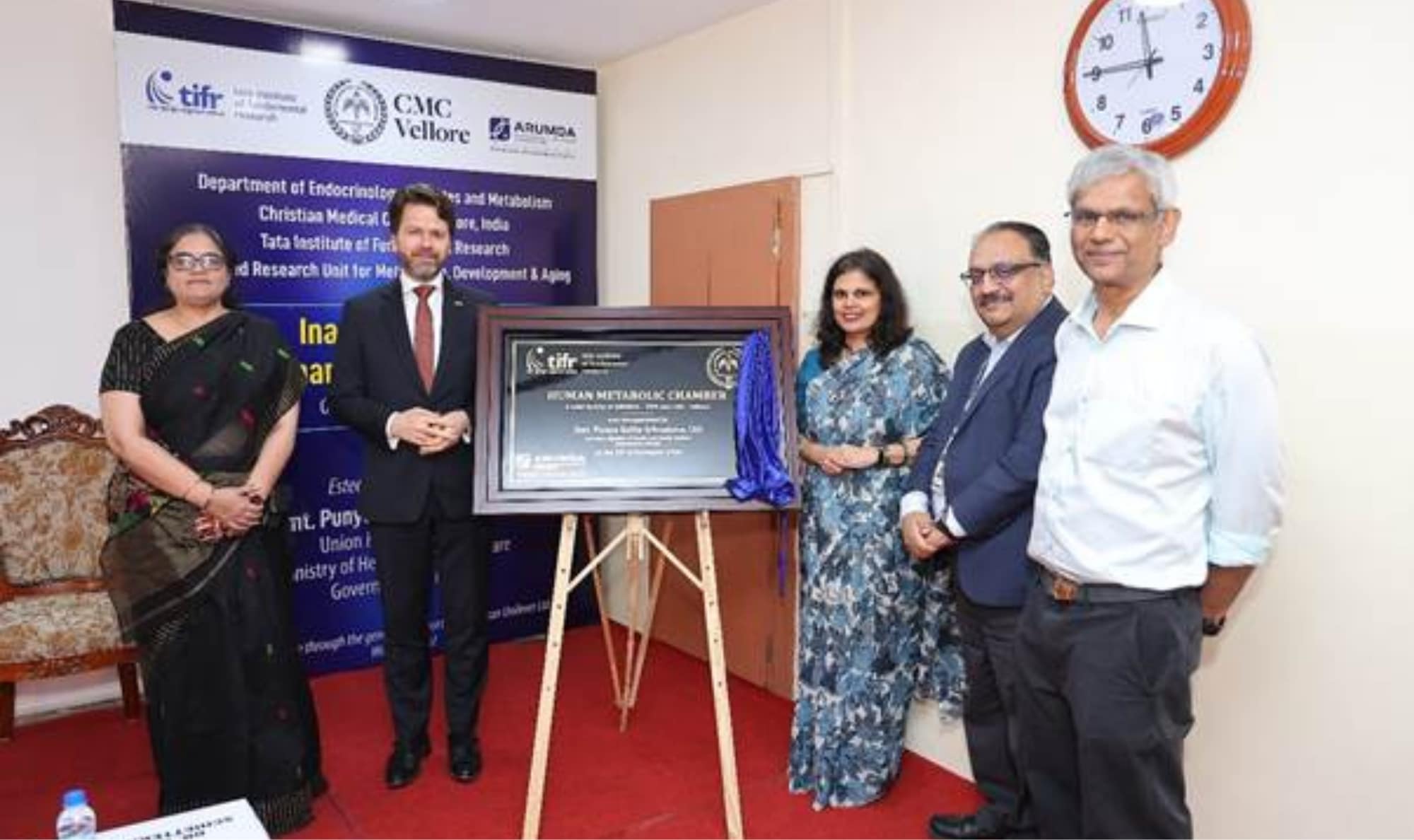
To preventive healthcare and biomedical research, Union Health Secretary Punya Salila Srivastava inaugurated India’s first dedicated Human Metabolic Chamber Facility at Christian Medical College (CMC), Vellore, on Monday.
Established jointly by the Tata Institute of Fundamental Research (TIFR) and CMC Vellore, the state-of-the-art facility is designed to deepen scientific understanding of human metabolism, nutrition, diabetes, obesity, and related metabolic disorders. Addressing the gathering, Smt. Srivastava emphasised the urgent need for robust, India-specific clinical evidence, noting that Western health benchmarks often fail to capture the unique genetic and metabolic risk profiles of the Indian population.
How the Facility Works
Unlike standard clinical testing, the Human Metabolic Chamber functions as a room-sized calorimeter. Volunteers live, eat, and sleep inside the sealed environment for 24 hours or longer while precision sensors continuously measure their oxygen consumption and carbon dioxide production.
This data allows researchers to calculate total energy expenditure and track exactly how the human body metabolises fats and carbohydrates across meals, physical activity, and sleep. The chamber complements the Advanced Research Unit on Metabolism, Development & Ageing’s (ARUMDA) National Analytical Facility for Nutrition and Metabolism Research—set up last year—by linking cellular and biochemical data directly with real-time whole-body energy utilisation.
Global and Institutional Collaboration
The project brings together TIFR’s analytical capabilities and CMC Vellore’s decades of clinical expertise in endocrinology, including landmark studies on insulin sensitivity in individuals with histories of low birth weight and undernutrition. Funded by the Department of Atomic Energy with Corporate Social Responsibility (CSR) support from Hindustan Unilever Limited, the facility also benefited from technical guidance by NUTRIM at Maastricht University and network support from the Embassy of the Kingdom of the Netherlands in India.
Strengthening Preventive Healthcare
Linking cutting-edge lab research to grassroots public health, Smt. Srivastava highlighted the government’s expanding preventive health network under the Ayushman Bharat Yojana:
-
Primary Screening: 1.87 lakh Ayushman Arogya Mandirs are conducting population-based screenings for non-communicable diseases (NCDs) and three common cancers for citizens over 30, backed by 781 district and 6,489 Community Health Centre NCD clinics.
-
Expanded Disease Coverage: Five additional conditions—including chronic obstructive pulmonary disease (COPD), stroke, and chronic kidney disease (CKD)—are being integrated into the National Programme for Non-communicable Diseases, alongside early risk identification for children under Rashtriya Bal Swasthya Karyakram (RBSK) 2.0.
-
Lifestyle & Nutrition Campaigns: Carrying forward Prime Minister Narendra Modi’s call to cut edible oil consumption by 10 per cent, initiatives like Sugar and Oil Boards, school awareness drives, and the ‘Aaj Se Thoda Kam’ campaign are gaining momentum. Over 7.8 crore cumulative yoga sessions have also been conducted at Ayushman Arogya Mandirs, while institutions like ICMR-NIN are developing AI-powered tools to help consumers decode the nutritional value of packaged foods.
Smt. Srivastava urged TIFR, ARUMDA, and CMC Vellore to collaborate closely with the Ministry of Health and Family Welfare and the Pan-AIIMS Research Consortium to build comprehensive, evidence-based national datasets for a healthier India.
The inauguration was attended by Prof. Biju George (Director, CMC Vellore), Prof. Jayaram Chengalur (Director, TIFR), Prof. Ullas Kolthur (Director, BRIC-CDFD), Nico Schiettekatte (Health Counsellor, Embassy of the Kingdom of the Netherlands), and senior scientists and faculty members from both institutions.