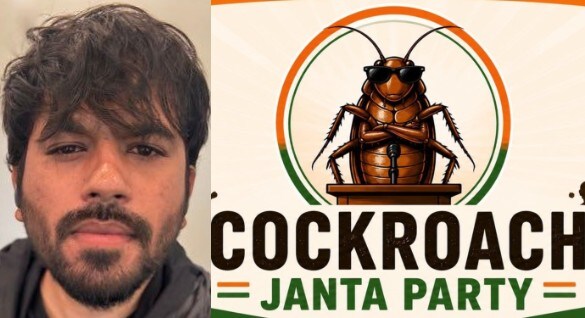
What started as an online joke has now snowballed into one of India’s biggest viral internet movements. The so-called Cockroach Janta Party (CJP) is dominating social media conversations with memes, satire, political commentary and growing youth participation.
Launched shortly after remarks made by Justice Surya Kant, the satirical movement has rapidly gained traction online with its quirky slogan — “Secular, Socialist, Democratic, Lazy.”
Calling itself “a political front of the youth, by the youth, for the youth,” the movement has triggered debates about politics, governance, public frustration and meme culture in India.
The group, founded by Abhijeet Dipke, claims it crossed more than 50,000 members within days of launch. Opposition leaders, meme pages, students and young professionals have all amplified the trend, helping the party dominate online conversations.
Cockroach Janta Party Goes Viral On Social Media
The movement has exploded across platforms like Instagram, X and Reddit within days.
According to online claims, the party’s Instagram page crossed 2 million followers, while its X account gathered tens of thousands of followers in a short span. The movement also reportedly attracted over one lakh online sign-ups.
Its rise has been fuelled by humorous posts, relatable memes and sarcastic takes on politics and bureaucracy — especially among younger internet users.
Social media users are now debating whether the movement is simply satire or a reflection of growing dissatisfaction with traditional political systems.
What is the Cockroach Janta Party’s manifesto?
The party’s manifesto combines satire with serious political demands focused on democratic institutions and accountability. Its proposals include:
- 50% reservation for women in Cabinet positions
- A 20-year election ban for MLAs and MPs who switch political parties
- A ban on post-retirement Rajya Sabha positions for Chief Justices
- Investigation into bank accounts of “godi media” anchors
- Action if legitimate votes are deleted during elections
The group has also backed students affected by the NEET controversy and demanded that the Central Board of Secondary Education scrap rechecking fees, calling them “blatant corruption”.
Prominent Voices React To Viral Trend
Several well-known personalities have reacted to the sudden popularity of CJP.
Senior advocate Prashant Bhushan said the movement reflected frustration among millions of young Indians seeking change in the political system.
Meanwhile, Sabeer Bhatia humorously described the Cockroach Janta Party as “the most stable ecosystem in the nation,” joking that cockroaches survive every scam, reform and political crisis.
The movement has also attracted attention from political figures including Mahua Moitra and Kirti Azad, both of whom joined the online conversation with witty exchanges.
Reddit Users Debate Whether CJP Could Become Serious
On Reddit, discussions around the movement have become increasingly intense.
Some users described the party as a potential “alternative to NOTA,” while others argued that India’s youth need a fresh political platform free from conventional party structures.
Many users also highlighted how the movement blends humour with genuine concerns over issues like corruption, unemployment, exam scams and political fatigue.
At the same time, some internet users questioned whether the movement could realistically evolve into a serious political force.
Who Started The Cockroach Janta Party?
The movement was started by Abhijeet Dipke, a 30-year-old student currently studying at Boston University.
Dipke previously studied journalism in Pune and reportedly worked with the social media team of Aam Aadmi Party between 2020 and 2022.
Despite its satirical origins, the movement’s manifesto has sparked wider discussions online about democracy, governance, constitutional values and youth participation in politics.
Why The Movement Resonates With Young Indians
Much of the movement’s popularity comes from its ability to convert frustration into humour.
Internet users say the Cockroach Janta Party reflects:
- Political fatigue among young voters
- Growing distrust in institutions
- Meme-driven digital activism
- Desire for more relatable leadership
- Frustration over corruption and unemployment
Whether the movement fades as a meme or transforms into something larger remains uncertain, but for now, it has become one of the internet’s most talked-about trends in India.