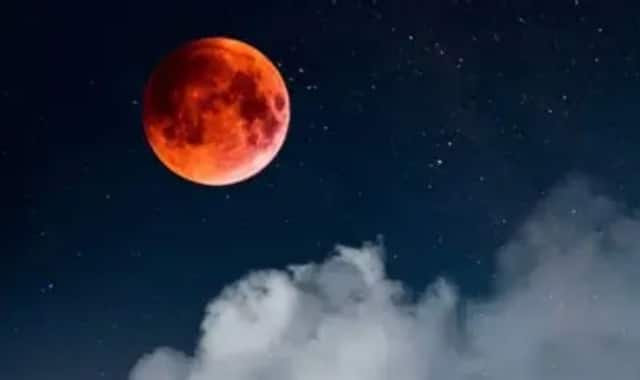
India will witness a rare total lunar eclipse, or Chandra Grahan, on March 3, 2026, coinciding with the festival of Holi.
The celestial event will begin at 3:20 PM IST and end at 6:46 PM IST, lasting 3 hours and 27 minutes. The Sutak period will start at 6:23 AM and continue until the eclipse concludes.
The eclipse will be visible across India, though most regions will see only the final stages as the Moon rises already in eclipse. Northeastern states such as Assam, Arunachal Pradesh, Meghalaya, and West Bengal will enjoy better visibility due to earlier moonrise. Cities like Delhi, Mumbai, Bengaluru, and Chennai will witness the eclipse between 6:20 PM and 6:30 PM IST.
During totality, which lasts about 58 minutes, the Moon will appear red, creating the phenomenon known as the Blood Moon. This occurs when sunlight bends through Earth’s atmosphere and casts a reddish glow on the lunar surface.
The penumbral phase begins at 4:58 PM IST, while the maximum eclipse occurs between 5:10 PM and 5:25 PM IST, depending on location. In Andaman & Nicobar Islands, Manipur, Mizoram, Nagaland, Tripura, and parts of the northeast, the total eclipse will be visible. Other states, including Delhi, Maharashtra, Odisha, and Tamil Nadu, will see a partial eclipse.
Globally, the eclipse will be visible across Europe, Asia, Australia, North and South America, and parts of the Pacific and Atlantic regions.
For best viewing, skywatchers should step outside at dusk, look toward the eastern horizon, and avoid bright city lights. Rooftops, beaches, and hilltops offer clear vantage points. Binoculars or telescopes can enhance the experience, but are not essential