The Bhubaneswar-Kataka Police Commissionerate has put a comprehensive, multi-layered security grid in place for the 7th Session of the 17th Odisha Legislative Assembly, scheduled from September 22 to October 3.
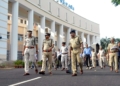
Today at around 3 PM, the Odisha DGP Vinaytosh Mishra, in the presence of Commissioner of Police, Dr. S. Dev Datta Singh, Addl. CP Narasingha Bhol, and other senior officers reviewed the security arrangements for the ensuing Assembly session.

A detailed press release issued today outlines officer-level deployments, quick-response teams, rooftop cover, medical and fire support, and even a dedicated unit to prevent self-immolation attempts.
Who is on the ground
The Commissionerate has listed:
- 2 DCPs, 6 Additional DCPs and 24 ACPs
- 134 officers of Inspector/SI/ASI/Woman Constable rank
- 1 Special Tactical Unit
- 36 platoons of force
- 60 traffic personnel (Havildars, Constables and Woman Constables)
Three control rooms will run round the clock — one at the Northern Gate of the Assembly, one at the Unified Control Room on M.G. Marg, and one at the designated dharna site.
Quick response and special measures
Eleven Quick Response Teams have been positioned: seven inside the Assembly, two mobile teams circling the precincts, one at Traffic PS-1 and one at Lok Seva Bhawan. A plainclothes team, monitored by the IIC of Capital Police Station, has been tasked specifically with preventing self-immolation bids — a recurring concern at Assembly sittings. Adequate rooftop deployment has been arranged at the Assembly itself, at other strategic points and at sensitive locations.
Support systems
A dedicated firefighting unit and a medical response team with an ambulance will stay at the Assembly. Logistics include ropes, PA-fitted vehicles, blankets, drinking water, searchlights, CCTV and photographers. Static VHF sets have been installed for seamless coordination. A temporary lock-up (hazat) will function at the Reserve Office of Bhubaneswar UPD for legal formalities. One Bomb Disposal Unit is on station, and drones will be used as required to watch crowd movement.
DCP Traffic will supervise parking inside the premises and outer traffic flow to reduce congestion. Separate drinking-water arrangements have been made for staff and visitors.
Traffic and access
Barricades and route restrictions already announced earlier in the week remain in force on session days. Only authorised and emergency vehicles will use designated approaches; separate entry arrangements are in place for legislators, ministers, the Speaker and the press. Daily anti-sabotage and dog-squad checks of the building before proceedings are part of the standard drill.
The Commissionerate says all units have been briefed and are prepared to handle any contingency. The stated objective is an incident-free session that lets the House function without disruption while keeping law and order intact in the surrounding area.