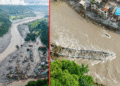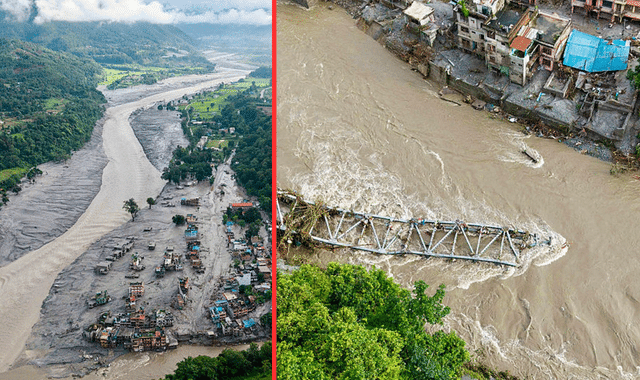
The catastrophic flood triggered by a glacial collapse along the Nepal–Tibet border has left at least 359 people dead in Nepal and more than 900 missing, while Tibet reports three deaths and 558 missing. Authorities warn the toll may rise as rescue operations continue in treacherous terrain.
The US Geological Survey confirmed the disaster was caused by a sudden glacial break and debris flow, unleashing torrents of water and mud downstream. Scientists are now investigating whether climate change played a role, noting that rising Himalayan temperatures have destabilized slopes and accelerated glacial melt.
In Nepal, more than 9,000 police, army, and armed forces personnel have been deployed to search for survivors and recover bodies. Families desperate for news of missing relatives have gathered at airports and border crossings, hoping for updates.
Among the missing are hundreds of foreign tourists, including 178 Indians, 65 Americans, and 33 Britons. A tour group of 20 tourists and seven Nepali staff vanished minutes after sending a video from the flood zone.
The crisis deepened as a rising lake formed near the China–Nepal border, raising fears it could burst within days. Nepal’s disaster authority has warned of secondary floods from blocked rivers, while engineers race to assess the risk.
Nepal’s Prime Minister Balendra Shah visited affected areas, ordering immediate relief and infrastructure restoration. In Tibet, the Communist Party urged members to support rescue efforts and maintain stability.
The disaster has reignited global concern about the vulnerability of Himalayan communities to climate‑driven glacial hazards.
As rescue teams battle blocked rivers and unstable terrain, the looming threat of the rising lake underscores the urgency of coordinated action. For families across Nepal, Tibet, and beyond, the wait for news remains agonizing.