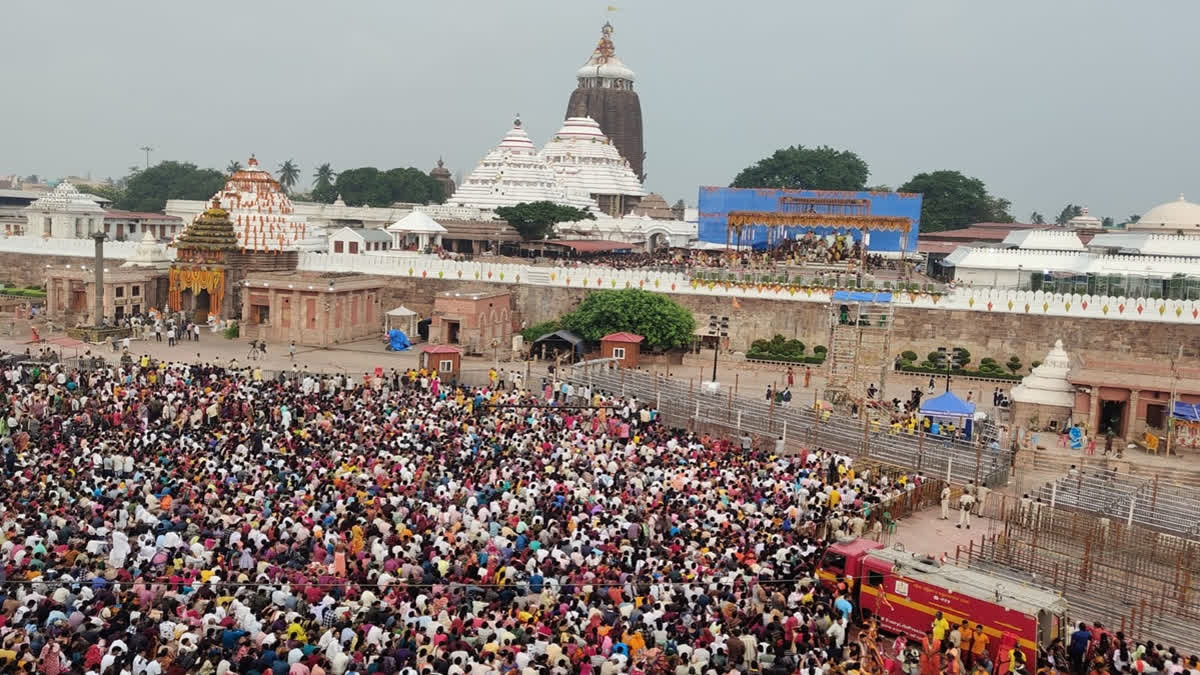
The holy town of Puri came alive on Monday as lakhs of devotees gathered to witness Snana Yatra 2026, one of the most important festivals associated with Lord Jagannath. The annual bathing ceremony of Lord Jagannath, Lord Balabhadra and Devi Subhadra marks the beginning of the rituals leading to the world-famous Rath Yatra.
Observed on the full moon day of the Hindu month of Jyestha, Snana Purnima offers devotees one of the rare opportunities to see the sibling deities outside the sanctum sanctorum of the Jagannath Temple.
Traditional Pahandi Procession Marks the Beginning
The celebrations began with the traditional Pahandi procession, during which the deities were ceremonially brought from the sanctum sanctorum to the Snana Mandap.
The atmosphere turned devotional as priests chanted Vedic hymns while conch shells, cymbals and traditional instruments echoed across the temple premises. Thousands of devotees lined the route to witness the centuries-old ritual.
108 Pots of Sacred Water Used for the Holy Bath
The central ritual of Snana Yatra involves bathing the deities with 108 pots of consecrated water collected from the temple’s sacred Sunakua, also known as the Golden Well.
The water is mixed with sandalwood paste, camphor and fragrant herbs before being offered to the deities. This ritual symbolises purification and devotion and has been observed for centuries.
Gajapati Maharaja to Perform Chhera Pahanra
Following the ceremonial bath, Puri Gajapati Maharaja Dibyasingha Deb is scheduled to perform the traditional Chhera Pahanra ritual at the Snana Mandap.
Later in the day, the deities will appear in the much-awaited Hati Besha, also known as Gajanana Besha, where they are adorned in an attire resembling Lord Ganesha. This special appearance attracts thousands of devotees every year.
Anasara Ritual Begins After Snana Yatra
After the bathing ceremony, the deities are believed to fall ill due to the elaborate ritual bath.
They will therefore remain in the Anasara Gruha for nearly a fortnight and will not be available for public darshan during this period. The deities will reappear during Nabajouban Darshan, shortly before the commencement of the annual Rath Yatra.
Tight Security and Crowd Management in Place
Authorities have implemented extensive security and crowd-management measures to ensure the smooth conduct of the festival.
According to officials, around 80 platoons of police personnel have been deployed across the Jagannath Temple, Grand Road and other sensitive locations.
Security arrangements include:
- Quick Action Teams (QATs)
- Sniffer dog squads
- Anti-sabotage checks
- Rooftop surveillance
- Marine security
- Real-time monitoring through the Integrated Command and Control Centre (ICCC)
In addition, help desks, police assistance centres, medical camps and dedicated facilities have been established for senior citizens, women, children and persons with disabilities to ensure a safe and comfortable pilgrimage experience.
Police Assure Smooth Conduct of Rituals
Puri Superintendent of Police Prateek Singh said that all security arrangements had been completed according to the ritual schedule.
He stated that police personnel had been deployed at every designated location and that authorities were monitoring the event closely to facilitate the smooth movement of devotees throughout the day.
Snana Yatra Sets the Stage for Rath Yatra 2026
Snana Yatra is one of the most spiritually significant festivals in the Jagannath tradition. The sacred bathing ceremony not only marks the ceremonial public appearance of the deities but also signals the beginning of preparations for the globally celebrated Rath Yatra.
With lakhs of devotees participating in this year’s festival, Puri once again reaffirmed its place as one of India’s most important centres of faith and pilgrimage.