
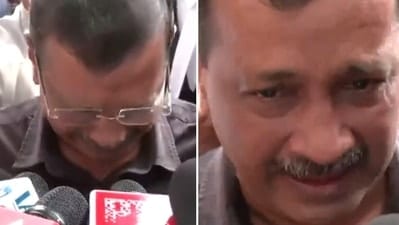
Former Delhi chief minister Arvind Kejriwal turned emotional on Friday after a Delhi court discharged him and 22 others in the Central Bureau of Investigation’s excise policy case.
Shortly after the verdict by the Rouse Avenue Court, Kejriwal addressed reporters and broke down mid-speech. “I am not corrupt. The court has said that Kejriwal and Manish Sisodia are kattar imaandaar (completely honest),” he said, as former deputy chief minister Manish Sisodia stood beside him.
Court Discharges All 23 Accused
The case, investigated by the Central Bureau of Investigation, pertained to alleged irregularities in the Delhi Excise Policy 2021–22 introduced during the Aam Aadmi Party (AAP) government’s tenure.
On Friday, Special Judge (PC Act) Jitender Singh ruled that there was no material to establish an overarching conspiracy or criminal intent in the formulation of the policy. The court discharged all 23 accused named in the chargesheet.
The court also reportedly questioned the investigative approach, observing that the alleged conspiracy narrative appeared to rely on conjecture rather than concrete evidence.
Background of the Case
The CBI registered the case in August 2022 based on a complaint by Delhi Lieutenant Governor V.K. Saxena. The agency alleged that modifications in the excise policy reduced licence fees and fixed profit margins in a way that benefited select private entities, resulting in losses to the state exchequer.
Kejriwal and Sisodia were arrested during the investigation. Over time, multiple supplementary chargesheets were filed.
However, the court’s order on Friday declined to proceed further, effectively halting the trial at the stage of framing of charges.
Political and Legal Implications
Reacting to the verdict, Kejriwal described the case as politically motivated and reiterated his party’s stance that the charges were unfounded.
Legal experts note that discharge at this stage means the court found insufficient evidence to frame charges and proceed to trial. The investigative agency may choose to challenge the order before a higher court.