
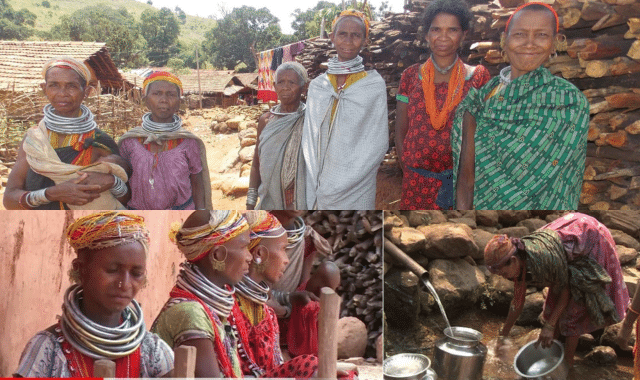
In the rugged hills of Malkangiri district in Odisha, the Bonda and Didayi tribes represent some of India’s most ancient indigenous communities. While the Didayi reside in the Kudumulugumma ghat, the Bonda people inhabit the Bondaghat area. Despite ongoing development efforts, Bondaghat remains deprived of basic amenities, leaving its residents in perpetual hardship.
Bondaghat encompasses two panchayats—Mudulipada and Andrahal—with a total of 32 villages. Among these, Barguda village in Mudulipada panchayat stands out as one of the most inaccessible. Perched about 8 kilometres uphill from the panchayat headquarters, it is home to 30 families and a population of 250. Shockingly, not a single resident is educated, primarily due to the absence of a school or anganwadi centre in the village. Children must trek 2 kilometres over steep hills to access education, a daunting task that has left over 30 kids out of school and engaged in household chores instead.
Infrastructure woes compound the villagers’ struggles. No road connects Barguda to the outside world, forcing residents to walk the arduous 8-kilometer path to the panchayat headquarters for essential rations and allowances. Health services are virtually non-existent; in medical emergencies, patients are carried on shoulders or makeshift cots to the nearest facility. Drinking water is another critical issue—there are no tube wells or wells, compelling Bonda women to walk miles to fetch water from distant sources.
Electricity remains a distant dream. Poles were installed years ago, but power has yet to arrive, leaving villagers reliant on traditional oil lamps to illuminate their nights. Government officials rarely visit, perpetuating the cycle of neglect and unresolved problems.
Lacking their own land, the Bonda people practice slash-and-burn (podu) cultivation in the forests for sustenance. They also gather forest produce, which they sell at local markets in exchange for necessities. In an era dominated by mobile technology, Barguda has no network coverage, and poverty prevents residents from owning phones. Many are so isolated that they remain unaware of what a mobile even is. Yet, amidst these challenges, the community clings fiercely to its traditions and culture.
Ironically, crores of rupees have been allocated for development through the block administration, the Integrated Tribal Development Agency (ITDA), and the Bonda Development Agency. However, Barguda seems to have been overlooked, with residents’ living conditions reminiscent of 50 years ago. The question lingers: when will the sorrows of Barguda’s Bonda inhabitants finally be alleviated?