Odisha Governor Dr. Hari Babu Kambhampati delivered a comprehensive address to the Odisha Legislative Assembly on the opening day of the Budget Session, unveiling ambitious long-term goals outlined in the state’s Vision Document for 2036 and 2047.
The document, formally launched by Prime Minister Narendra Modi in June 2025, aims to position Odisha as a leading driver of India’s development journey toward a “Viksit Bharat” by the centenary of Independence.
In his 67-page speech, the Governor highlighted transformative targets, including raising the state’s per capita income from the current ₹1.8 lakh to ₹32 lakh by 2047. This sharp increase is expected to elevate living standards significantly, extend life expectancy beyond 80 years, and eradicate anaemia and malnutrition while reducing multidimensional poverty to below 5%.
Economically, the Vision sets Odisha on course to achieve a $500 billion economy by 2036 — coinciding with the centenary of Odisha’s formation as a separate province — and expand to a $1.5 trillion economy by 2047. The state’s contribution to India’s national GDP is targeted to rise from around 3% to 5%, supported by an average annual growth rate of 7% to 9.5%. Key drivers include enhanced investment attraction, with 343 large industrial projects already approved, and a strong push in renewable energy, aiming for 10 GW capacity by 2030.
The Governor praised ongoing initiatives in education, such as the Godabarish Ideal Primary School scheme and the introduction of over 45,000 pre-primary classes under the National Education Policy, benefiting more than 3.2 lakh children. New textbooks aligned with the revised National Curriculum Framework will be implemented from the 2026-27 academic year for classes 1 to 8 in government schools.
Women’s empowerment received special mention, with schemes like Lakhpati Didi, self-help groups, and Subhadra Shakti Melas driving economic independence. In health, increased budgets and efforts to curb Maoist influence were noted: over the past five years, 48 Maoists were killed, 78 arrested, and 82 surrendered, with significant arms recoveries in 2025 alone.
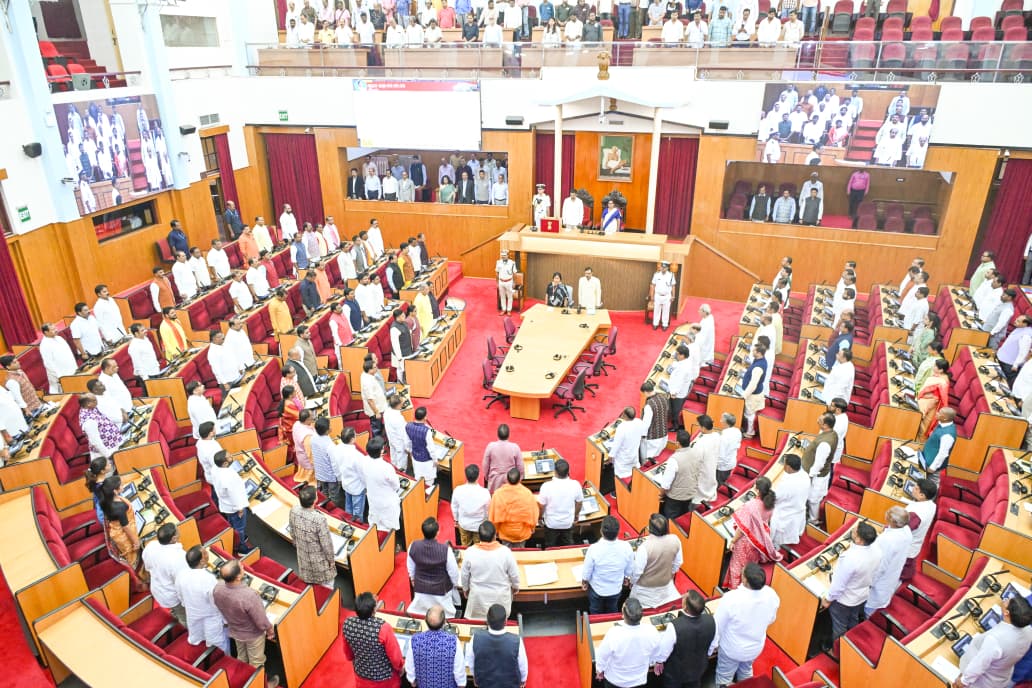
The session began with a historic first: “Vande Mataram” (the national song) was sung before “Jana Gana Mana” (the national anthem), following a recent Government of India directive prioritising the national song in official programs. This marked a departure from previous practice, where only the national anthem was performed during the Governor’s entry and exit.
The proceedings opened with tributes to departed former members, including ex-Union Minister Kanhu Charan Lenka, former MLAs Akshaya Kumar Acharya, Kulamani Rout, ex-MLA Sanchita Mohanty, and Dr. Rasheshwari Panigrahi.
Chief Minister Mohan Charan Majhi moved a condolence motion, supported by Leader of Opposition Naveen Patnaik, Congress leader Ramchandra Kadam, and CPM’s Laxman Munda. A one-minute silence was observed.
However, the address faced opposition’s dissent. BJD and Congress MLAs staged a walkout, criticising it as mere praise for the government without substantive messages for the state. Former Chief Minister Naveen Patnaik joined the protest. CPM’s lone MLA and two suspended BJD MLAs remained in the House.
The Governor invoked poet Robert Frost’s lines — “I shall be telling this with a sigh somewhere ages and ages hence: Two roads diverged in a wood, and I — I took the one less traveled by” (adapted in Odia as a call to persevere without fatigue) — to urge relentless progress. He emphasised Odisha’s readiness to lead as a growth engine in India’s development, with no room for complacency in serving the people.
The Budget Session continues, with expectations of detailed financial proposals reflecting these visionary goals.