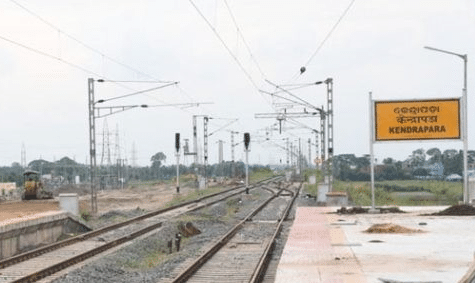
In a testament to perseverance and high-level intervention, the Haridaspur-Paradeep New Rail Line, an 82-kilometre corridor in Odisha, stands as a beacon of infrastructure success after overcoming decades of delays.
Sanctioned on January 1, 1997, by the Ministry of Railways and executed by Rail Vikas Nigam Limited (RVNL), this ₹1,186 crore project was designed to forge a direct, high-capacity link between eastern India’s mineral-rich hinterlands and Paradeep Port, one of the nation’s premier deep-water ports.
The rail line addresses longstanding bottlenecks in freight transportation, particularly for coal, iron ore, fertilisers, petroleum products, and containerised cargo. By eliminating circuitous routes and capacity constraints, it shortens the rail distance to the port by approximately 40 kilometres, slashing logistics costs by ₹300–400 per tonne and enhancing Paradeep’s competitiveness as a maritime hub. Operationally, the corridor now supports 20–25 additional freight trains daily, saving about four hours per rake and improving overall efficiency by 25–30%. Engineered to withstand Odisha’s challenging coastal terrain, it features two major bridges over the Luna and Mahanadi rivers, along with 201 additional bridges.
However, the project’s journey was far from smooth. Implementation faced typical hurdles of linear infrastructure in densely populated and ecologically sensitive areas: land acquisition delays across 39 villages, forest and wildlife clearances, environmental approvals, construction licenses, and financial setbacks. These issues, categorised under land acquisition (5 instances), forest/environmental (6), construction approvals (4), and finance (2), stalled progress despite the project’s strategic importance.
The turning point came in August 2018 when the project was escalated to the Prime Minister’s PRAGATI (Pro-Active Governance and Timely Implementation) platform. Flagged for review due to persistent land acquisition and overall implementation challenges, it drew direct directives from the Prime Minister. The Government of Odisha was instructed to acquire and hand over the remaining land by December 2018, while the Ministry of Railways and state authorities were urged to expedite execution, targeting completion of the Haridaspur-Kendrapara section by November 2018 and the full line by February 2019.
This high-level nudge sparked a wave of coordinated action. The District Collector of Jajpur, Ambar Kumar Kar, spearheaded focused interventions, including structured compensation mechanisms and direct dialogues with landowners. By December 28, 2018, compensation was disbursed in 18 villages, with physical possession handed over in 15, allowing construction to resume. The remaining land was fast-tracked, fully resolved by January 2019. Regular reviews—once under PRAGATI, four by Odisha’s Chief Secretary, and three in PMG meetings—ensured accountability and momentum.
Key figures like RVNL’s Chief Project Manager Pradeep Kumar Mohanty and Ministry of Railways’ Executive Director Vivek Kumar played pivotal roles in on-ground coordination. The result? The project achieved 100% physical progress and was commissioned on July 31, 2020, marking a shift from stagnation to swift delivery.
Beyond freight, the corridor’s impact is multifaceted. Socially, it has introduced passenger and MEMU services, enhancing daily mobility for workers, students, and traders in Jajpur, Kendrapara, and Jagatsinghpur districts. In a cyclone-prone region, it bolsters disaster response and supply-chain resilience. Environmentally, by diverting freight from roads to rails, it reduces emissions, eases highway congestion, and promotes safer, greener transport—all while minimising land disruption and preserving natural drainage.
The first passenger train flagged off in March 2024 symbolised the project’s broader promise: not just a freight artery, but a catalyst for balanced regional development. As Odisha cements its role in India’s industrial and maritime economy, the Haridaspur-Paradeep line exemplifies how targeted governance can transform stalled visions into vital realities.