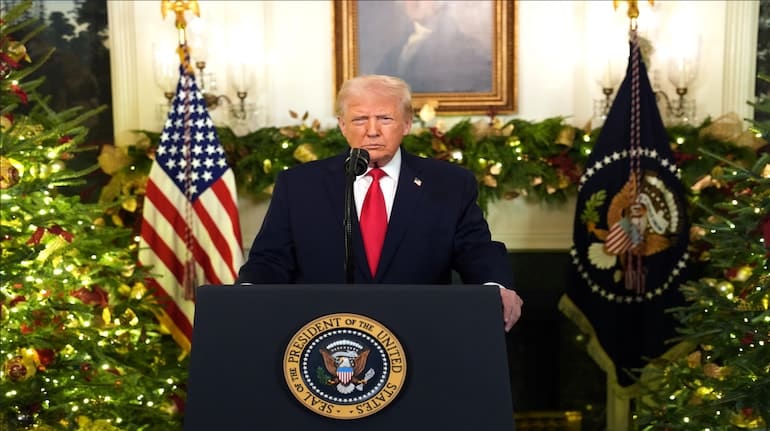
US President Donald Trump has ordered the suspension of the Diversity Visa (DV) green card lottery program, days after authorities revealed that the suspect in the deadly Brown University shooting had entered the United States through the scheme.
The directive was confirmed by Homeland Security Secretary Kristi Noem, who said she has instructed the United States Citizenship and Immigration Services (USCIS) to immediately pause the program.
Link to Brown University Shooting
The decision follows a fatal shooting at Brown University that left two students dead and nine others injured. Investigators identified the suspect as Claudio Neves Valente, a 48-year-old Portuguese national.
Authorities also linked Valente to the killing of MIT professor Nuno Loureiro, who was shot at his home in Brookline, Massachusetts, two days after the Brown University attack.
According to officials, Valente entered the US through the DV1 diversity visa program and later obtained lawful permanent resident (green card) status in 2017.
“This heinous individual should never have been allowed into our country,” Noem wrote in a post on X.
She added that Trump had previously sought to end the program following the 2017 New York City truck attack, in which an ISIS-linked assailant also entered the US under the DV program.
Suspect Found Dead After Manhunt
After an extensive multi-state manhunt across New England, law enforcement officials found Valente dead on Thursday (local time). Authorities said he died from a self-inflicted gunshot wound, and confirmed there is no ongoing threat to public safety.
Valente had previously studied at Brown University, where he was enrolled from fall 2000 to spring 2001, according to the Associated Press.
What Is the Green Card Lottery Program?
The Diversity Immigrant Visa Program, commonly known as the green card lottery, grants up to 50,000 immigrant visas each year to individuals from countries with historically low rates of immigration to the United States.
According to USCIS, most lottery winners apply from outside the US and immigrate through consular processing after receiving approval.
The suspension marks a significant policy shift and is expected to trigger legal and political debate, particularly among immigration advocates and lawmakers.