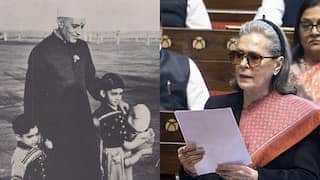
The Congress on Thursday strongly criticised the BJP-led central government after it sought the return of 51 cartons of documents related to India’s first prime minister, Jawaharlal Nehru, from senior party leader Sonia Gandhi to the Prime Ministers’ Museum and Library (PMML).
Reacting to the development, Congress MP Imran Masood accused the government of being fixated on Nehru while ignoring pressing national issues such as air pollution and the weakening rupee.
“They have nothing left except Nehru. Even in their dreams, Nehru appears. Breathing has become difficult in Delhi and across north India, the rupee is falling against the dollar, and the economy is under strain, but the government is not concerned about these issues,” Masood said.
The demand for the return of the documents has reignited a long-running political dispute between the ruling Bharatiya Janata Party (BJP) and the Congress over the custody and access to Nehru-era papers.
Row Over Nehru Papers
The controversy centres on 51 cartons of documents related to Jawaharlal Nehru that were taken back by Sonia Gandhi from the then Nehru Memorial Museum and Library (NMML) in 2008. The NMML, located at Teen Murti Bhawan—Nehru’s official residence for 16 years—was renamed the Prime Ministers’ Museum and Library in 2023.
A section within the PMML has since pushed for the “reclaiming” of the documents, arguing that they are of national importance and should be accessible to scholars, researchers, Parliament, and the public.
Union culture minister Gajendra Singh Shekhawat said the papers were formally handed over to the Nehru family in 2008 following an official request and that proper records and catalogues were maintained. He clarified that the documents are not missing and that their location is known.
However, the government has now sought their return, asserting that such historically significant records “belong in public archives, not behind closed doors.”
Government’s Stand on Transparency
Shekhawat said scholars, students, and citizens have a right to access original source material to gain a balanced and truthful understanding of Nehru’s life and legacy.
“On one hand, we are told not to debate the blunders of that era. On the other, primary source material that enables informed debate is kept out of public access. This contradiction cannot be ignored,” he said.
Emphasising transparency as a democratic principle, the minister added that archival openness is a moral obligation and should not be selectively applied.
The issue continues to fuel political sparring between the Congress and the BJP, with both sides framing the debate around historical legacy, public access, and governance priorities.