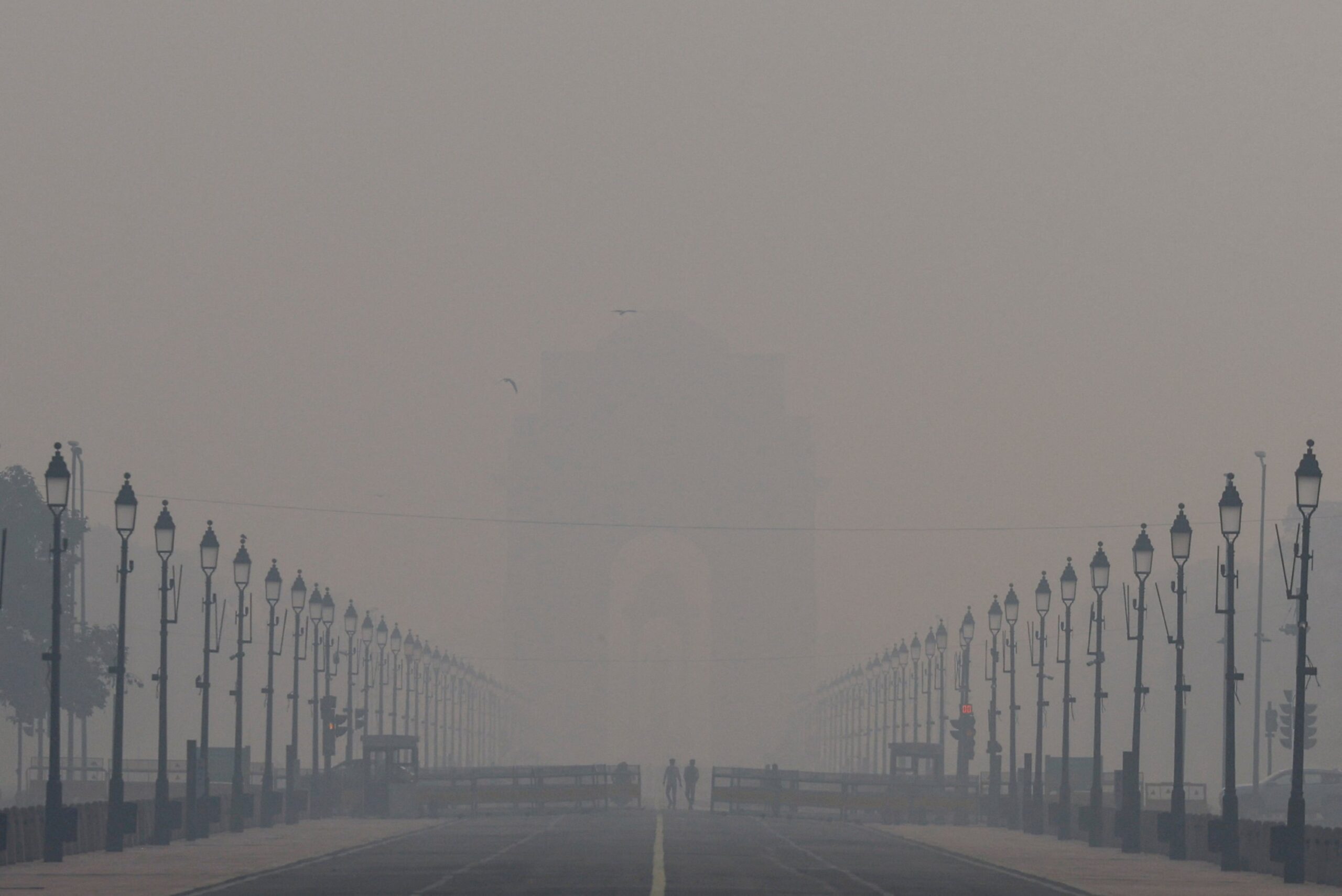
The national capital, New Delhi, is shrouded in dense smog, with the visibility of its iconic landmark India Gate reduced to a faint silhouette. The city’s Air Quality Index (AQI) has been consistently registering in the ‘poor’ to ‘very poor’ range, prompting criticism from opposition parties and raising questions over monitoring integrity and remedial measures.
According to monitoring data, in key areas of Delhi and surrounding NCR regions, AQI levels have soared past 300-plus, entering the ‘very poor’ category, with occasional pockets reaching ‘severe’. The worsening air quality has coincided with visible smog blanketing the skyline and covering major thoroughfares.
The Aam Aadmi Party (AAP) has directly invoked the obscured India Gate to criticise the ruling government, asserting that “India Gate has disappeared … No matter how much the government tampers with the AQI, India Gate has exposed the BJP’s true colours by vanishing behind the smog.” The Indian National Congress echoed similar concerns, pointing to what they called a “grey shroud” enveloping the capital.
AAP leader Saurabh Bharadwaj went further to allege that trucks from the Municipal Corporation of Delhi were being used to spray water around pollution-monitoring stations at night—an actor says is meant to artificially lower AQI readings. He displayed video footage taken outside a station near ISBT, claiming the water spray operation was timed to skew results. These allegations feed into wider concerns about AQI transparency and data tampering.
Congress leader Priyanka Gandhi called on both the central and Delhi governments to come together in a “socio-political consensus on climate action,” noting that the air pollution engulfing the city was akin to a “grey shroud thrown over it.” Meanwhile, the Shiv Sena (UBT) leader Aaditya Thackeray described the pollution levels as “worrisome,” and criticised apparent strategies aimed at hiding real AQI numbers rather than confronting the underlying problem.
On the mitigation front, government agencies are reportedly deploying water-sprinkler trucks, anti-smog guns, and have mooted cloud-seeding experiments to try to induce rain and clear particulate matter. However, experts say such measures can offer only temporary relief if primary sources—such as vehicular emissions, construction dust, industrial output and stubble burning in nearby states—are not tackled in a sustained way.
For residents, the impact has been immediate: decreased visibility, irritated eyes and throats, coughing, and rising respiratory discomfort even among those without previous conditions. One local near India Gate remarked: “We are more tired running, need frequent breaks because of pollution.”
Given the recurring nature of Delhi’s wintertime air-quality crisis, analysts emphasise that structural change is required—from improving public transport and construction controls, to enforcing agricultural-residue burning bans, and upgrading emission-monitoring transparency.