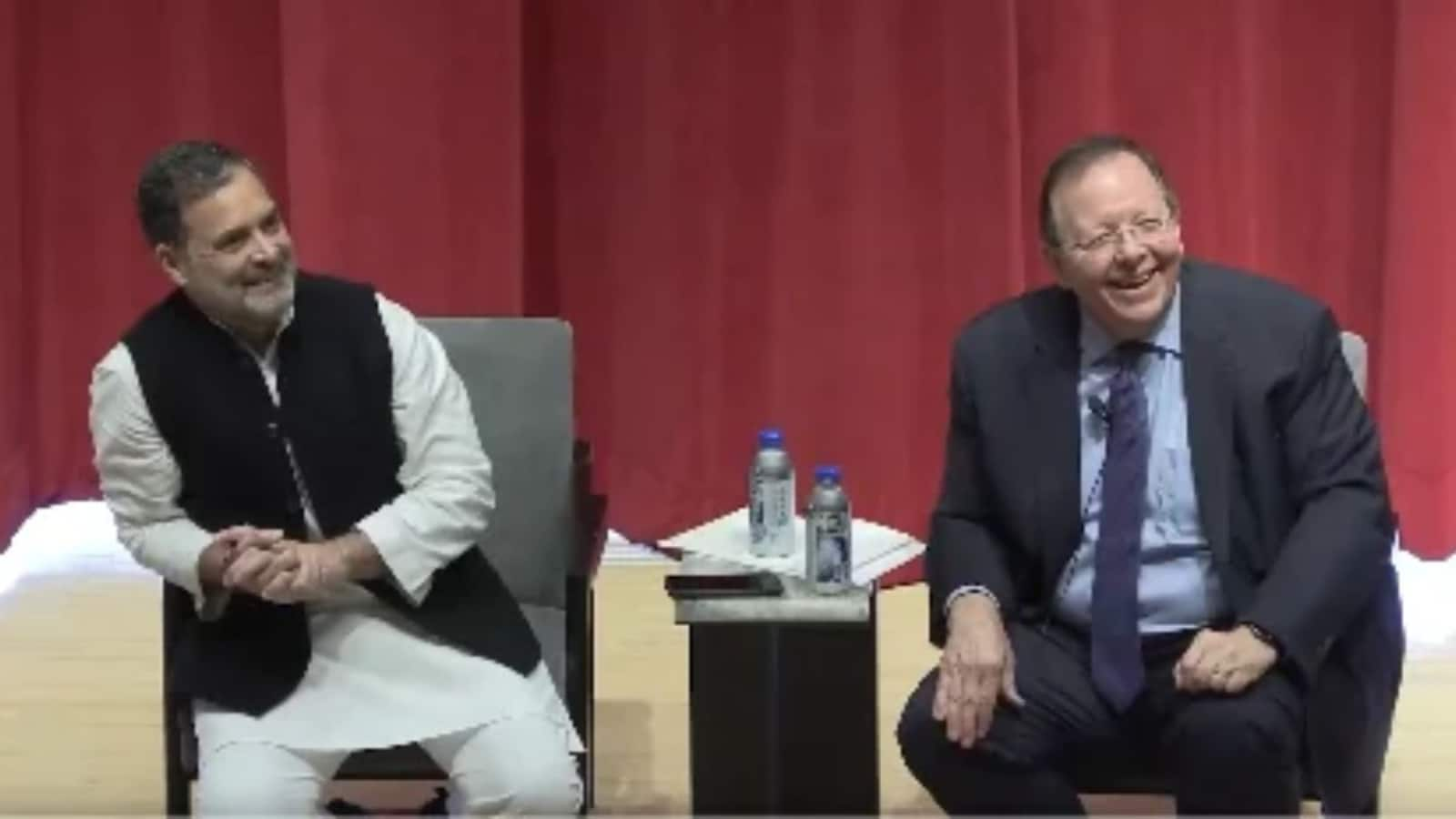
Leader of the Opposition in the Lok Sabha Rahul Gandhi said dialogue between India and Pakistan can begin only if Islamabad stops supporting and encouraging terrorism in India, responding to a Pakistani national during an interaction with students at the University of Chicago on Wednesday, November 18, 2026.
Asked by the participant whether the two countries could “move beyond the blame game and work together for mutual benefit” without allowing outside factors to widen their divide, Gandhi stated that while space for engagement exists in principle, ongoing killings of innocent people make talks impossible until terror backing ends.
On Pakistan Talks, Global Role & BJP’s Sharp Retort
Gandhi stressed that India cannot accept innocent citizens being murdered while holding talks with Pakistan, adding that a conversation can potentially start the moment support for terrorism stops.
Questioning the Narendra Modi government’s foreign policy during the event and in a follow-up post on X on Thursday, November 19, Gandhi argued that India had become a “side player” in global affairs—pointing to Pakistan’s mediation role between the United States and Iran while invoking India’s Non-Aligned Movement (NAM) legacy and calling for a multipolar global order shaped by India, the US, China, Russia, and the Middle East. The Bharatiya Janata Party (BJP) sharply criticised his remarks, with national spokesperson CR Kesavan accusing Gandhi of acting as a “cheerleader” and “propagandist” for Pakistan.
“There is room, but there is a big problem, which is the support and encouragement of terrorism by Pakistan in our country. And it is impossible for us to accept our innocent people being murdered and having a conversation with Pakistan. So the moment that stops, then a conversation can potentially begin.”
— Rahul Gandhi, Leader of the Opposition in Lok Sabha (at the University of Chicago)
Personal Diplomacy vs. Geopolitical Realities
Gandhi also contended that foreign relations are driven by national interests and economic structures rather than personal rapport between leaders, saying he had no issue with friendly ties but urged a clearer assessment of India’s geopolitical standing amid global shifts including the conflict involving Iran.