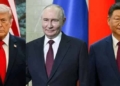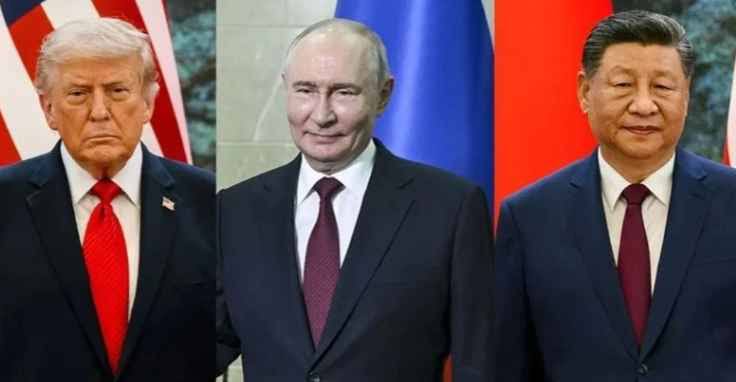
Confirmation from Beijing on Monday, November 16, 2026, that US President Donald Trump, Chinese President Xi Jinping, and Russian President Vladimir Putin will hold their first-ever trilateral summit in Shenzhen, China, on Thursday, November 19—on the sidelines of the Asia-Pacific Economic Cooperation (APEC) summit—has triggered widespread diplomatic anxiety across Ukraine, Europe, Japan, and Taiwan.
While White House spokesperson Olivia Wales stated that Trump will press for discussions on nuclear non-proliferation, the sight of Washington, Beijing, and Moscow convening behind closed doors has drawn sharp comparisons to the 1945 Yalta Conference, raising fears that major powers could carve out spheres of influence without consulting affected nations.
Why Allies & Neighbours Are Warning Against a ‘Yalta 2.0’
In February 1945, Allied leaders Franklin D. Roosevelt, Winston Churchill, and Joseph Stalin met in Crimea to map out post-World War II Europe—a summit long criticized for deciding the fate of smaller nations without their presence. Similar alarms are now ringing ahead of Shenzhen:
- Ukraine & the European Union: Ukrainian President Volodymyr Zelensky has warned against the summit becoming “Yalta 2, 3, 4, with a redistribution of influence.” Meanwhile, European policy analysts caution that negotiating the four-year-old Ukraine war at a China-hosted table without Kyiv or EU representatives could further strain deteriorating China–EU relations.
- Japan & Taiwan: In the Indo-Pacific, Tokyo fears regional security decisions could be shaped over its head despite its alliance with Washington, prompting Japanese Prime Minister Sanae Takaichi to seek separate talks with Trump during this week’s ASEAN summit in Manila. Similarly, Taiwan is watching closely amid concerns that any US willingness to compromise on Ukraine could signal vulnerability for Taipei.
Moscow’s Response & What Each Leader Seeks in Shenzhen
Kremlin spokesperson Dmitry Peskov played down Yalta comparisons, stating that global order must rest on mutual respect rather than imposed decisions, though Russian nationalist voices have hailed the three-way summit as symbolic proof of a multipolar world:
-
- Strategic Stakes: Analysts note that Putin sees an opening to push for favourable terms on Ukraine, Trump aims to project global dealmaking strength and pursue trilateral nuclear arms control following recent domestic electoral setbacks, and Xi seeks to showcase Beijing’s diplomatic stature while hosting 21 APEC economies.
”We really don’t want this to turn into ‘Yalta 2, 3, 4,’ with a redistribution of influence.”
— Volodymyr Zelensky, President of Ukraine