India stands at the threshold of becoming a global leader in the next great industrial revolution, driven by biotechnology, artificial intelligence, and genomics.
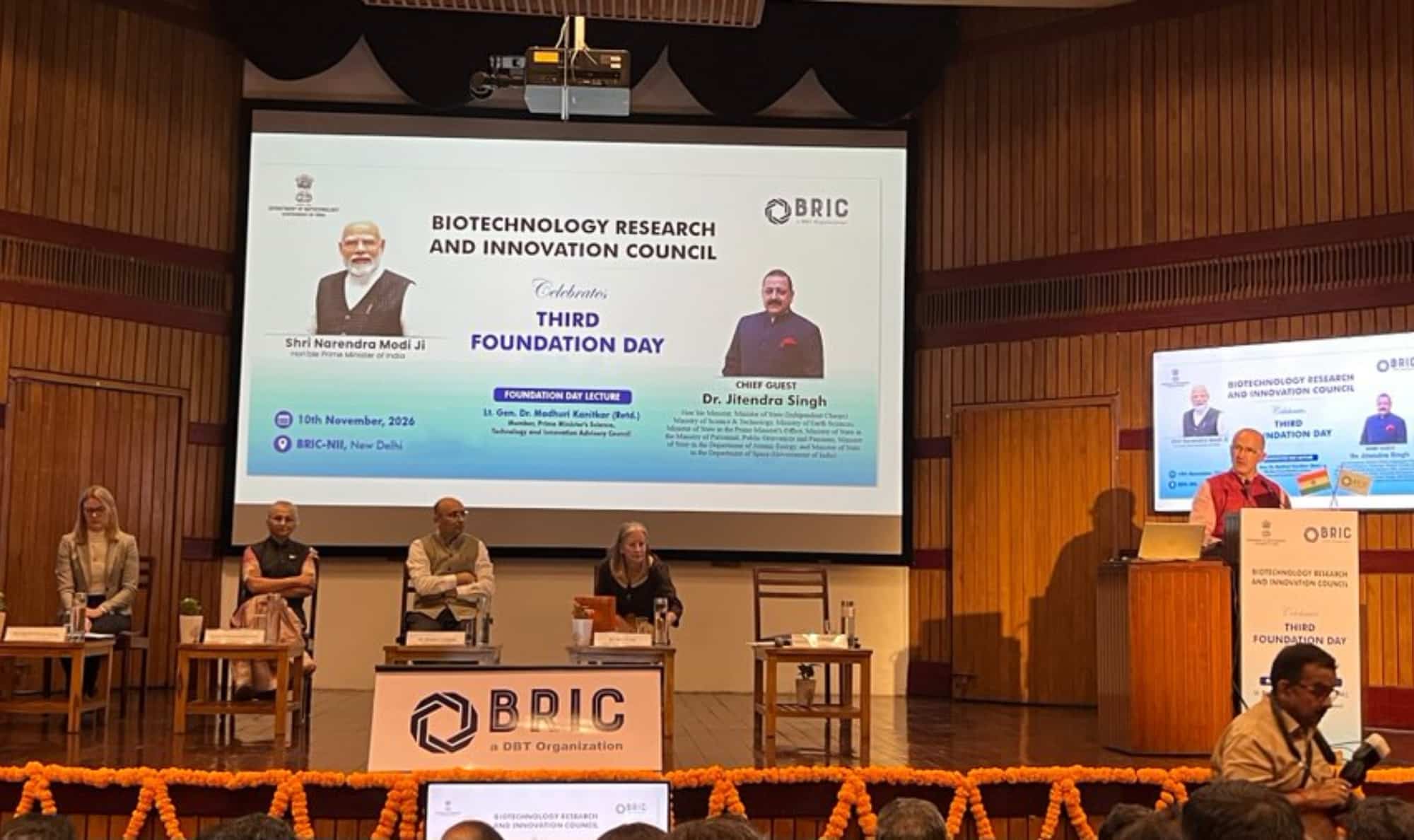
This powerful vision was articulated by Union Minister of State for Science and Technology, Dr Jitendra Singh, during the grand celebration of the Biotechnology Research and Innovation Council’s (BRIC) third Foundation Day, held today at the BRIC–National Institute of Immunology (NII).
Addressing scientists, policymakers, and industry leaders, Dr Singh highlighted the phenomenal growth of India’s bioeconomy, which has expanded from roughly USD 10 billion to over USD 195 billion. The nation’s startup landscape has experienced an equally dramatic transformation, scaling from just 50–60 startups to more than 11,000 high-impact ventures, many displaying immense global potential.
Breaking Down Silos: The “Joint Family” Model
A cornerstone of the Minister’s address was the success of BRIC’s integrated model. Designed to unify India’s 13 premier biotechnology institutions across 11 cities into a decentralised national network, BRIC acts as a “joint family.” Member institutions pool vital resources while maintaining their independent identities and autonomy, effectively slashing bureaucratic delays and accelerating cross-disciplinary collaboration.
Dr Rajesh S. Gokhale, Secretary of the Department of Biotechnology and Director General of BRIC, emphasised that this unified vision connects laboratory innovations directly with market applications. By anchoring initiatives in trust, culture, and resource optimisation, BRIC aims to advance sovereign technologies and secure India’s position as a global biotech powerhouse.
Global Partnerships and Strategic Milestones
The event was marked by high-profile international and domestic announcements aimed at cementing India’s manufacturing and research prowess:
-
UK-India Biomanufacturing Collaboration: BRIC and the UK’s Centre for Process Innovation signed a pivotal Letter of Intent to strengthen bilateral cooperation in biomanufacturing and support biofoundries.
-
Major Funding Boost: The Wellcome Trust announced a monumental grant of up to Rs 21.7 crore for a five-year immersion training program dedicated to over 250 iBRIC+ PhD scholars.
-
Biofoundry Hubs: Strategic hubs have been established across Mohali, Hyderabad, Pune, and Thiruvananthapuram to pioneer high-performance biomanufacturing and AI-integrated workflows.
Empowering the Next Generation
Investing in human capital remained a central theme of the celebrations. The i3C PhD program, which immerses scholars in cross-sector research across health and agriculture, has already benefited nearly 200 students. Furthermore, the event recognised exceptional talent, honouring Dr Sunil Laxman (BRIC-inStem), Dr Rashna Bhandari (BRIC-CDFD), and Prof. Bhabatosh Das (BRIC-THSTI) with the prestigious iBRIC+ Spotlight Scientist of the Year–2026 awards.
With the government opening wider doors for private-sector participation through the Anusandhan National Research Foundation and BIRAC, India’s scientific community is uniquely positioned not just to adopt technology, but to pioneer the next industrial era from the ground up.