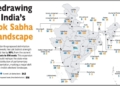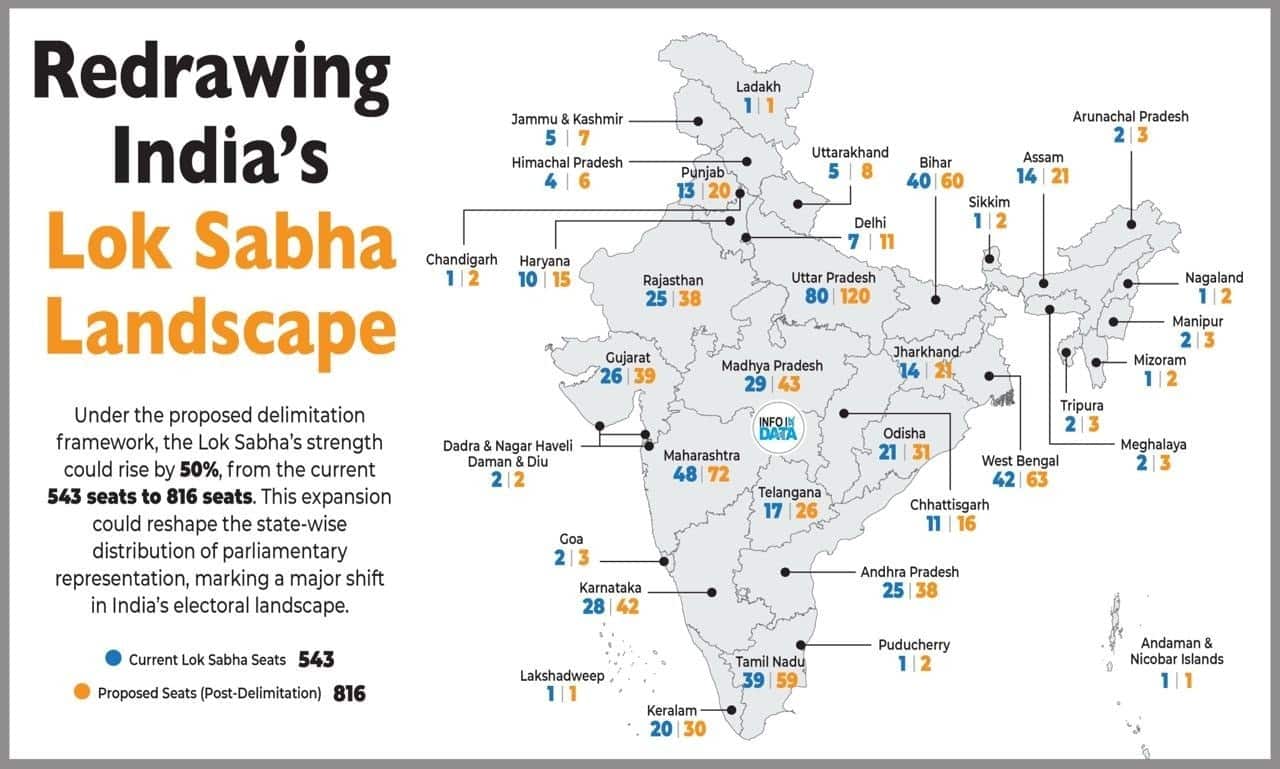
A day after the Union Cabinet cleared two revised delimitation legislations ahead of Monday’s special Parliament sitting, Union Minister of State (Independent Charge) for Law and Justice and Minister of State for Parliamentary Affairs Arjun Ram Meghwal on Saturday, November 28, 2026, unveiled the government’s projected post-delimitation Lok Sabha map—illustrating how the Lower House’s effective strength would expand from 543 to 816 seats through a uniform 50% increase across states and Union Territories.
Sharing the state-wise electoral graphic on X, Meghwal described the proposed framework as a “significant step towards reshaping India’s parliamentary landscape” and advancing inclusive democracy alongside the rollout of 33% women’s reservation ahead of the 2029 general elections.
How the 543-to-816 Seat Math & Rounding-Off Formula Work
- Uniform 50% Hike & 2051 Freeze: Scheduled for introduction in the Lok Sabha during the four-day special Parliament sitting concluding on December 3 (with Lok Sabha reconvening on Monday and Rajya Sabha on Wednesday), the Constitution (132nd Amendment) Bill, 2026 and the Delimitation (Second) Bill, 2026 guarantee a proportional 50% seat increase for every state and Union Territory while freezing inter-state seat shares until 2051.
- Rounding Off Odd-Numbered States & Single-Seat UTs: While the draft text of the bills does not explicitly spell out the rounding-off rule for states with an odd number of existing Lok Sabha seats, the official map shared by Meghwal shows fractional figures rounded up to the next whole number—lifting Tamil Nadu from 39 to 59 seats (from 58.5), Andhra Pradesh from 25 to 38 (from 37.5), Telangana from 17 to 26 (from 25.5), and Punjab from 13 to 20 (from 19.5). Similarly, single-seat Union Territories round up from 1 to 2 seats (a 100% increase), bringing the total elected strength to 816.
“The proposed delimitation framework marks a significant step towards reshaping India’s parliamentary landscape.”
— Arjun Ram Meghwal, Union MoS (I/C) for Law & Justice and MoS for Parliamentary Affairs (November 28, 2026)
Presidential Nod & Political Reactions Ahead of Tabling
- President Murmu’s Article 117(3) Recommendation: Ahead of its introduction in the Lower House, President Droupadi Murmu recommended consideration of the Delimitation (Second) Bill, 2026 under Article 117(3) of the Constitution, which governs legislative bills involving expenditure from the Consolidated Fund of India.
- Regional & Opposition Positioning: While the Bharat Rashtra Samithi (BRS) signalled conditional backing—stating that the uniform hike ensures “no injustice to Telangana” and no drop in southern representation—the INDIA bloc continues to demand that women’s reservation be implemented within the existing 543 seats without expanding the House.
Projected Post-Delimitation Lok Sabha Seats (543 to 816 Model)
|
State / Union Territory |
Current Seats |
Projected Seats (+50% Rounded) |
Change |
|---|---|---|---|
|
Uttar Pradesh |
80 |
120 |
+40 |
|
Maharashtra |
48 |
72 |
+24 |
|
West Bengal |
42 |
63 |
+21 |
|
Bihar |
40 |
60 |
+20 |
|
Tamil Nadu |
39 |
59 |
+20 |
|
Madhya Pradesh |
29 |
44 (43–44) |
+15 |
|
Karnataka |
28 |
42 |
+14 |
|
Gujarat |
26 |
39 |
+13 |
|
Andhra Pradesh |
25 |
38 |
+13 |
|
Rajasthan |
25 |
38 |
+13 |
|
Odisha |
21 |
32 (31–32) |
+11 |
|
Keralam |
20 |
30 |
+10 |
|
Telangana |
17 |
26 |
+9 |
|
Assam |
14 |
21 |
+7 |
|
Punjab |
13 |
20 |
+7 |
|
Haryana |
10 |
15 |
+5 |
|
Delhi (NCT) |
7 |
11 |
+4 |
|
Jammu & Kashmir (UT) |
5 |
7–8 |
+2–3 |
|
Total Lok Sabha Strength |
543 |
816 |
+273 |