Migration in Odisha is no longer merely a labour-market phenomenon, it is emerging as a key driver of social development, wellbeing, and regional growth.
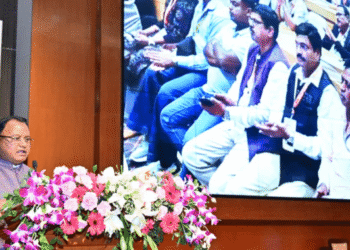
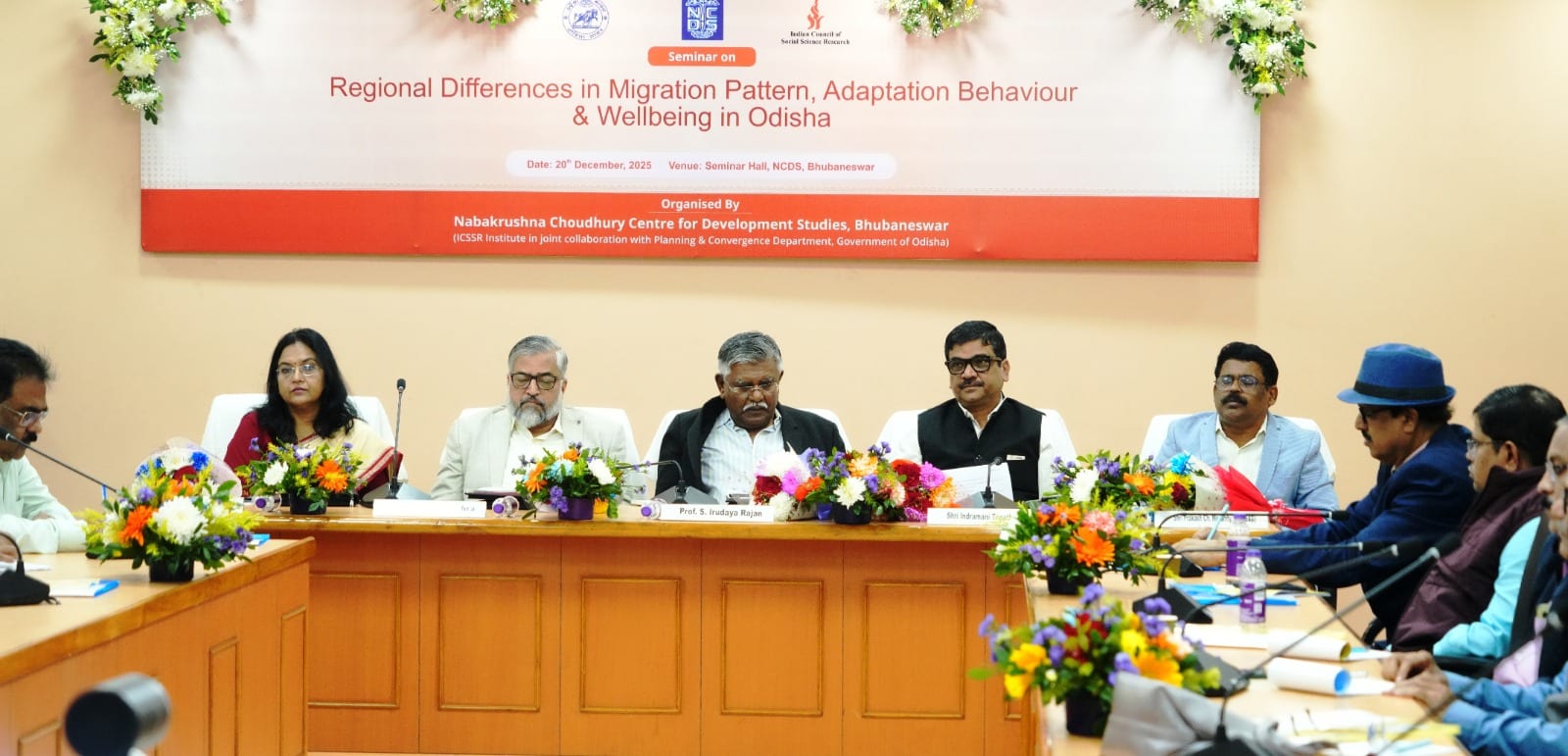
The Nabakrushna Choudhury Centre for Development Studies (NCDS), Bhubaneswar, hosted a landmark one-day seminar on “Regional Differences in Migration Pattern, Adaptation Behaviour and Wellbeing in Odisha”, bringing together senior government officials, eminent scholars, and researchers to discuss actionable strategies for inclusive migration policies.
This seminar was held under the guidance of Smt. Anu. Garg, IAS , Development Commissioner-cum-Additional Chief Secretary to Govt and Chairpersons of NCDS.
Shri Indramani Tripathy, IAS, Labour Commissioner of Odisha, Prof. S. Irudaya Rajan, Chairman, International Institute of Migration and Development and former Professor , Centre for Development Studies, Kerala, Prof. Udaya Shankar Mishra, International Institute for population Sciences , Mumbai were the dignitaries and keynote speakers participated and delivered on the topic and shared their valuable observations and policy-oriented recommendations for addressing regional disparities in migration and improving migrant wellbeing in Odisha.”
Welcoming the dignitaries, Shri Prakash Chandra Mohanty, Director, NCDS, emphasized the transformative potential of evidence-driven research. Based on a survey of over 650 households, the study delves into regional variations in migration patterns, adaptation behaviours, and wellbeing outcomes. “Migration is not a problem to be solved, it is an opportunity to improve lives, enhance social security, and empower families,” Shri Mohanty remarked. He highlighted the silent challenges faced by older persons and children left behind, and the structural nature of forced migration, urging policies that are human-centred and region-specific.
The seminar’s highlight was the presentation by Dr. Sandhya Rani Mahapatro, Project Director and Associate Professor at NCDS. Her groundbreaking research reframes migration as a multidimensional wellbeing issue, moving beyond economic perspectives to explore social, emotional, and health dimensions. Drawing from field evidence, Dr. Mahapatro showed how migrants and their families actively adapt to challenges, yet remain vulnerable without adequate institutional support. She stressed that interventions targeting social security, housing, health, and livelihoods can create transformative outcomes for both migrants and source communities.
“Migration is a story of resilience, adaptation, and opportunity,” Dr. Mahapatro noted. Her findings reveal regional inequalities in migration trajectories and the need for migrant-sensitive policies tailored to local realities. The upcoming report, to be submitted to ICSSR and the Odisha government, promises to provide practical guidance for policymaking, ensuring that migration strengthens rather than strains communities.
From the policy implementation perspective, Shri Tripathy, Labour Commissioner of Odisha, highlighted Odisha’s proactive initiatives. “We are working to make migration safer and more rewarding,” he said, citing a toll-free helpline (18003456703), help desks in destination states, portability of welfare schemes, and the creation of a comprehensive migrant database. He also pointed out that these initiatives help ensure timely compensation, grievance redressal, and access to social protection for Odisha’s migrant workforce.
Prof. S.I. Rajan, Chairman, International Institute of Migration and Development, stressed the critical importance of robust data in shaping policies. Referencing Kerala’s pioneering migration surveys and Odisha’s own 15,000-household study, he underlined the value of “numbers in guiding evidence-based decisions.” Prof. U.S. Mishra added that migration is a mutually reinforcing process linking source and destination regions, driven by both displacement and development, and that policies must reflect this duality to unlock benefits for all.
The afternoon technical sessions expanded the focus to include distress migration among indigenous communities, climate-induced mobility, corridor-specific inequalities, and informal sector vulnerabilities, with contributions from Dr. Grace Bahalen Mundu, Dr. Baishali Goswami, Dr. Madhusudan Nag, and Prof. Tara Nair. State officials from the Department of Labour and ESI shared updates on migrant welfare programmes, registration, and inter-state coordination.
The seminar concluded on a forward-looking note: Odisha has opportunity to lead by example, turning migration into a vehicle for inclusive growth, resilience, and social wellbeing. Dr. Sandhya Mahapatro’s research, in particularoffers practical insights, demonstrating that with data-driven, human-centred policies, migration can enhance livelihoods, strengthen communities, and ensure that no one is left behind.Odisha is poised to transform migration from a challenge into an opportunity, setting a model for other states and signalling a new era of evidence-based, people-focused development.