

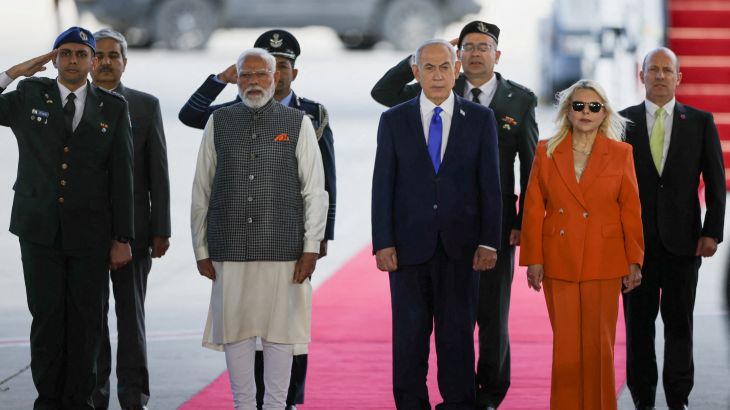
Prime Minister Narendra Modi landed in Tel Aviv on Wednesday at approximately 4:15 PM (IST) for his two-day state visit to Israel. This marks his second official visit to Israel during his tenure, following his landmark 2017 trip.
His six-hour flight became the most tracked aircraft worldwide on Wednesday, according to flight monitoring data, reflecting heightened global interest in the visit.
Ceremonial Welcome and High-Level Meetings
Upon arrival, Prime Minister Modi received a ceremonial welcome and was greeted by Israeli Prime Minister Benjamin Netanyahu and his spouse.
The two leaders are scheduled to hold bilateral talks reviewing progress in the India–Israel Strategic Partnership. Key areas of discussion include:
-
Science and technology
-
Innovation and startups
-
Defence and security cooperation
-
Agriculture and water management
-
Trade and economic ties
-
People-to-people exchanges
Prime Minister Modi will also call on Israeli President Isaac Herzog during the visit.
First Indian Prime Minister to Address the Knesset
In a historic milestone, Modi will become the first Indian Prime Minister to address the Knesset, Israel’s parliament. His address places him among select global leaders, including former US President Donald Trump and Argentine President Javier Milei, who have previously spoken there.
Following the parliamentary address, the leaders are expected to attend a private dinner.
Strategic Timing Amid Regional Tensions
The visit comes amid heightened geopolitical tensions in the Middle East, particularly concerning US-Iran relations. Officials from India’s Ministry of External Affairs stated that both leaders will exchange perspectives on regional and global developments of mutual interest.
The visit aims to reaffirm the deep and long-standing strategic partnership between India and Israel, while strengthening cooperation between two democratic nations navigating complex regional dynamics.
Opposition Voices Concerns
The visit has drawn political reactions within India. The Indian National Congress criticised the timing of the trip, expressing concerns about the humanitarian situation in Gaza and the occupied West Bank.
Congress leader Jairam Ramesh stated that the visit comes amid international criticism of Israeli policies. Party leader Priyanka Gandhi Vadra urged the Prime Minister to address humanitarian concerns during his Knesset speech.
Responding to the criticism, Bharatiya Janata Party spokesperson Gaurav Bhatia defended the government’s diplomatic approach.
What’s on the Agenda?
According to India’s Ministry of External Affairs, the visit will:
-
Review progress in the India–Israel Strategic Partnership
-
Explore expansion of bilateral trade, including discussions on a proposed Free Trade Agreement (FTA)
-
Enhance collaboration in defence, agriculture, water innovation, and emerging technologies
-
Address shared regional and global security concerns
The visit signals continued momentum in India–Israel relations and underscores India’s expanding diplomatic engagement in West Asia.
Why This Visit Matters
The 2026 Israel visit reinforces India’s evolving foreign policy strategy — balancing strategic interests, economic partnerships, and diplomatic engagement across the Middle East. With growing cooperation in defence, technology, and trade, the India–Israel partnership continues to deepen.
Prime Minister Modi’s address to the Knesset is expected to further elevate bilateral ties and set the tone for future collaboration.