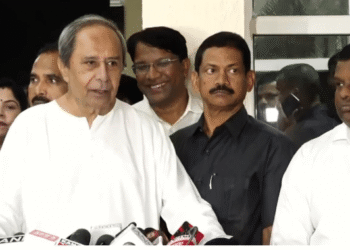

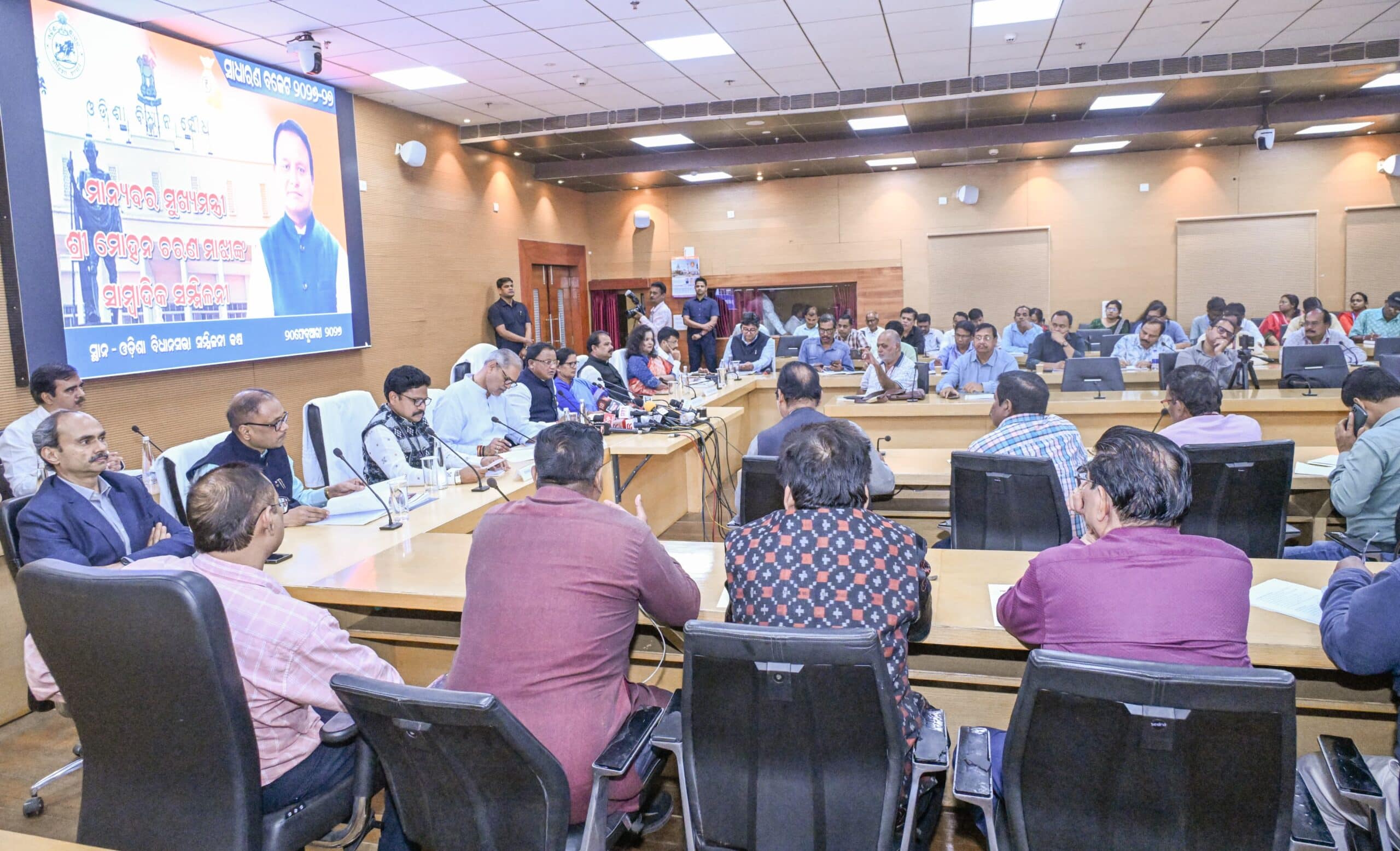
Odisha Chief Minister Mohan Charan Majhi today highlighted the key features of the state’s ₹3.10 lakh crore budget for 2026-27 in a post-presentation press conference, describing it as a decisive step towards building a prosperous, empowered, and inclusive Odisha aligned with the national vision of Viksit Bharat@2047 and Odisha@2036.
The budget, an increase of ₹20,000 crore over the previous year, allocates ₹1.80 lakh crore (58%) to programme expenditure and a record ₹72,100 crore to capital outlay — equivalent to 6.5% of the state’s GSDP and 23.3% of the total budget, the highest among India’s major states.
The Chief Minister emphasised saturation coverage under the Madhubabu Pension Yojana (MBPY), announcing that all eligible senior citizens and vulnerable persons currently excluded — over 6 lakh people — will be immediately brought under social security pension schemes.
Women and child welfare received strong focus, with ₹16,152 crore for the Women & Child Development department and ₹2,804 crore for Mission Shakti. A new flagship scheme, **Mukhyamantri Kanya Sumangal**, was unveiled to promote girls’ education: economically weaker families will receive a ₹20,000 savings instrument in the name of each girl child, maturing to ₹1.01 lakh upon completion of graduation.
Agriculture and allied sectors have been allocated ₹42,492 crore — a 12.3% increase — including ₹6,088 crore for assured paddy procurement under the Samruddha Krushak Yojana and a ₹5,000 crore revolving fund for timely farmer payments. New initiatives such as Shri Anna Abhiyan, crop diversification, and the Balabhadra Organic Farming Mission aim to boost farmer income and nutritional security.
To address rural distress migration, the Chief Minister proposed the **DALKHAI** initiative (Dignified Access to Livelihood, Knowledge, Health and Allied Infrastructure) for coordinated, sustainable livelihood creation. The state will also supplement central funds to extend employment guarantee to 125 days under the upcoming VBJI-RAM-JI scheme.
Tourism allocation rose 25% to ₹1,023 crore, with major projects including an ₹800 crore world-class museum in Bhubaneswar, a marine aquarium in Puri, riverfront development along five locations at ₹500 crore, and a Tourism Land Bank to create 25,000 hotel rooms by 2047. Eco-tourism centres and restoration of Chilika Lake and Nandankanan Zoo are also prioritised.
In education and skill development, four new universities will be established in Kendrapara, Jagatsinghpur, Bhadrak, and Jharsuguda, raising the total to 21. New government engineering colleges, AYUSH medical colleges, veterinary, agriculture, and fisheries colleges were also announced.
Concluding his address, the Chief Minister invoked Lord Jagannath’s blessings and called the budget a reflection of the aspirations of Odisha’s 4.5 crore people, built on fiscal responsibility and inclusive growth.