
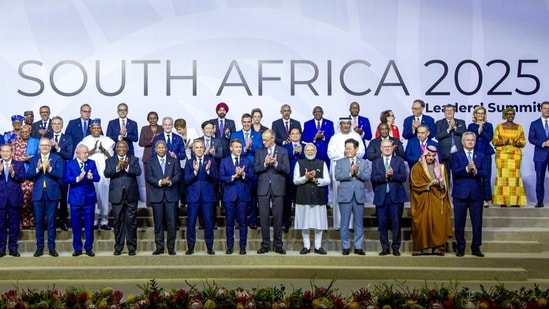
World leaders convened in Johannesburg for the G20 Leaders’ Summit 2025, which opened with President Cyril Ramaphosa emphasising South Africa’s commitment to preserving the group’s integrity and ensuring that the priorities of the Global South and African nations remain central to the discussions.
The three-day summit began on November 21, with Prime Minister Narendra Modi arriving a day earlier for bilateral engagements, including a meeting with Australian Prime Minister Anthony Albanese. In a post on X, Modi said he looked forward to productive discussions on key global issues.
Below are the major takeaways from the ongoing summit.
1. PM Modi’s Six-Point Agenda for Global Cooperation
Prime Minister Modi presented a comprehensive six-point proposal outlining India’s vision for future G20 collaboration. His agenda includes:
1. Countering the Drug–Terror Nexus
A coordinated global initiative to curb drug trafficking and its links to terrorism.
2. Global Healthcare Response Team
A specialised team comprising medical professionals from G20 nations for rapid deployment during health emergencies and disasters.
3. Africa-Skills Multiplier Initiative
A long-term programme aimed at workforce development across Africa, reinforcing India’s commitment to the continent’s growth.
4. Global Traditional Knowledge Repository
A platform to archive and share traditional knowledge systems for global well-being.
5. Open Satellite Data Partnership
A proposal to enhance international cooperation through shared satellite data for development and disaster management.
6. Critical Minerals Circularity Initiative
A roadmap for efficient utilisation, recycling and sustainability of critical minerals.
2. G20 Adopts Climate Declaration Amid US Boycott
The summit adopted its declaration on the opening day, advancing commitments on the climate crisis and global development.
The document was finalised without US participation, following Washington’s decision to boycott the event.
US officials accused South Africa of mishandling the G20 presidency, with the White House stating that the presidency was being used to undermine the group’s founding principles. The boycott followed earlier criticism by President Trump regarding South Africa’s domestic policies.
3. Focus on Critical Minerals and Sustainable Development
The G20 declaration introduced a Critical Minerals Framework, recognising the strategic importance of these resources in an era of rapid digitisation, clean energy transitions and technological innovation.
The framework aims to:
-
Support sustainable and inclusive economic growth
-
Ensure producing countries—especially in the Global South—benefit equitably from their resources
-
Address challenges such as underinvestment, inadequate technology and limited value addition
4. Call to Scale Up Global Climate Finance
The declaration echoed the urgency of expanding climate finance “from billions to trillions” to meet global needs.
It emphasised:
-
Closing energy-access gaps, particularly in Africa
-
Enhancing investments in renewable energy
-
Strengthening early warning systems for climate-related disasters
This announcement came shortly after the COP30 climate negotiations concluded with a major agreement.
5. Ukraine Conflict Stays in Focus on Sidelines
While Ukraine appeared briefly in the 30-page declaration, the subject remained prominent in discussions among Western leaders outside the main agenda.
The declaration calls for “just, comprehensive and lasting peace” in Ukraine, Sudan, the Democratic Republic of Congo and the Occupied Palestinian Territory.
European leaders discussed responses to the leaked details of US President Donald Trump’s 28-point peace plan and signalled that further work was required. They also pledged continued coordination with Ukraine and the United States.