

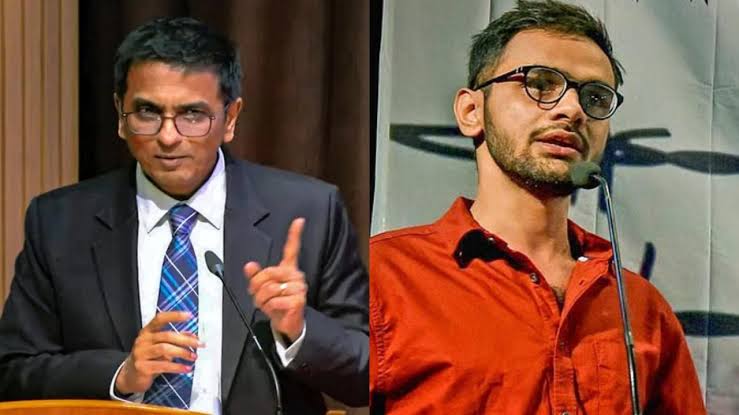
Former Chief Justice of India (CJI) D Y Chandrachud on Sunday said that denial of bail cannot be used as a form of punishment, especially when criminal trials are delayed. Referring to the repeated rejection of bail to activist Umar Khalid, Chandrachud stressed that bail should be the rule if an expeditious trial is not possible.
Umar Khalid has remained in judicial custody since September 2020, with his trial yet to begin.
‘Presumption of Innocence Is Being Undermined’
Speaking at the Jaipur Literature Festival, Chandrachud said the criminal justice system is founded on the principle that every accused person is presumed innocent until proven guilty.
“Pretrial detention cannot become punishment,” he said. “If a person spends five to seven years in jail before trial and is later acquitted, how do you compensate for that lost time?”
He explained that bail can only be denied under three well-established exceptions—if the accused is likely to repeat the offence, tamper with evidence, or flee from justice. “If these exceptions are not made out, bail must be granted,” he said.
Concerns Over National Security Laws
Chandrachud cautioned that several laws, particularly those related to national security, have reversed the foundational principle of innocence.
“Many of these laws have substituted the presumption of innocence with an almost presumption of guilt,” he observed, adding that courts must scrutinise such cases with greater care.
He emphasised that Article 21 of the Constitution, which guarantees the right to life and personal liberty, also includes the right to a speedy trial.
“If a speedy trial is not possible under present conditions, then bail should be the rule, not the exception,” he said.
Judicial Backlog and Culture of Distrust
The former CJI noted that during his tenure, courts disposed of over 24,000 bail applications, but a growing public distrust in institutions has made judges—especially in lower courts—reluctant to grant bail.
This fear of scrutiny, he said, often leads courts to push even simple matters to higher judiciary levels, contributing to the Supreme Court handling nearly 70,000 cases annually.
“No Supreme Court in the world, except perhaps Brazil’s, deals with such a volume,” Chandrachud remarked.
Call for Transparency in Collegium System
Chandrachud also called for greater transparency in the judicial appointments process to strengthen public confidence in the collegium system.
He explained that judicial appointments undergo multiple levels of scrutiny—from High Courts and state governments to Intelligence Bureau vetting—before reaching the Supreme Court.
“The answer lies in greater transparency,” he said, proposing that selection criteria for judges be made public on the Supreme Court’s website.
The remarks were made during a session titled ‘Ideas of Justice’, in conversation with journalist Vir Sanghvi.